← Back to practice

Specimen photograph credits

Photographs are licensed individually as shown below. The original photographer retains the applicable rights. Local copies are resized and converted to WebP without cropping; any share-alike license remains attached to the corresponding image.

Specimen identities are supported by source descriptions and a visual suitability review. One photograph represents one appearance, not every possible variety. The review does not constitute laboratory identification.

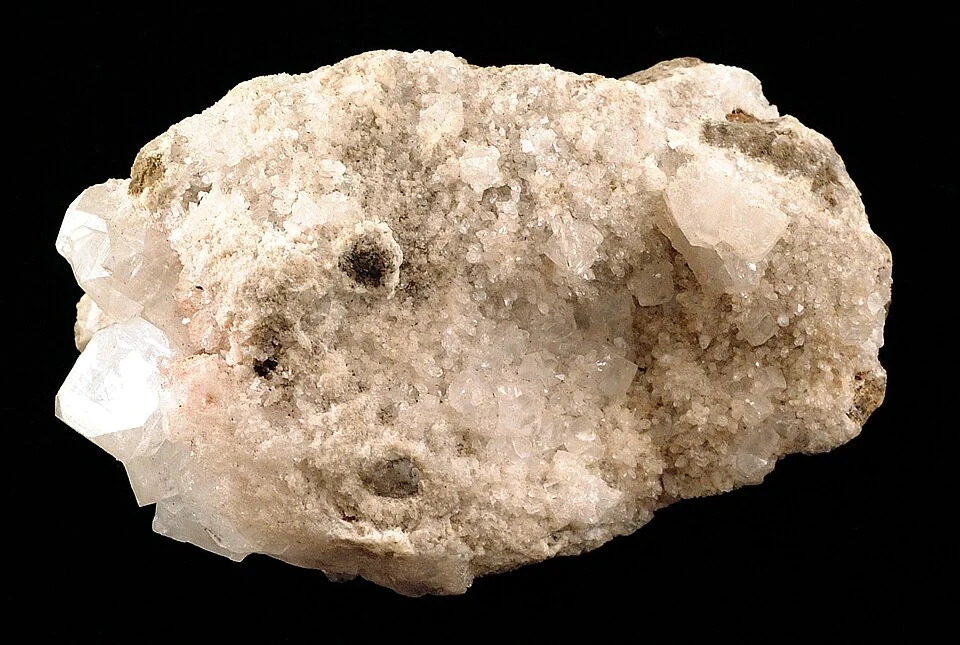
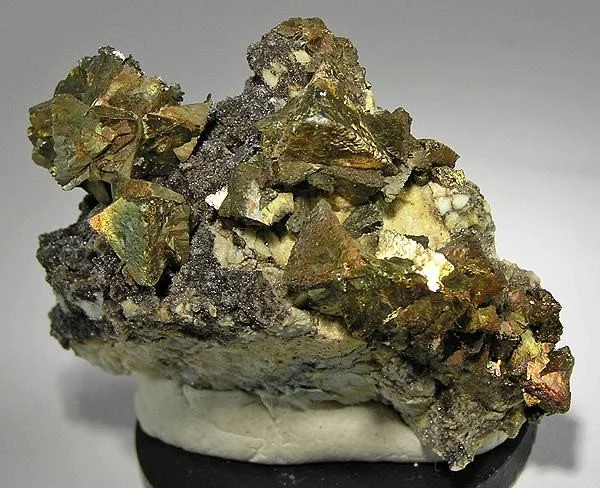
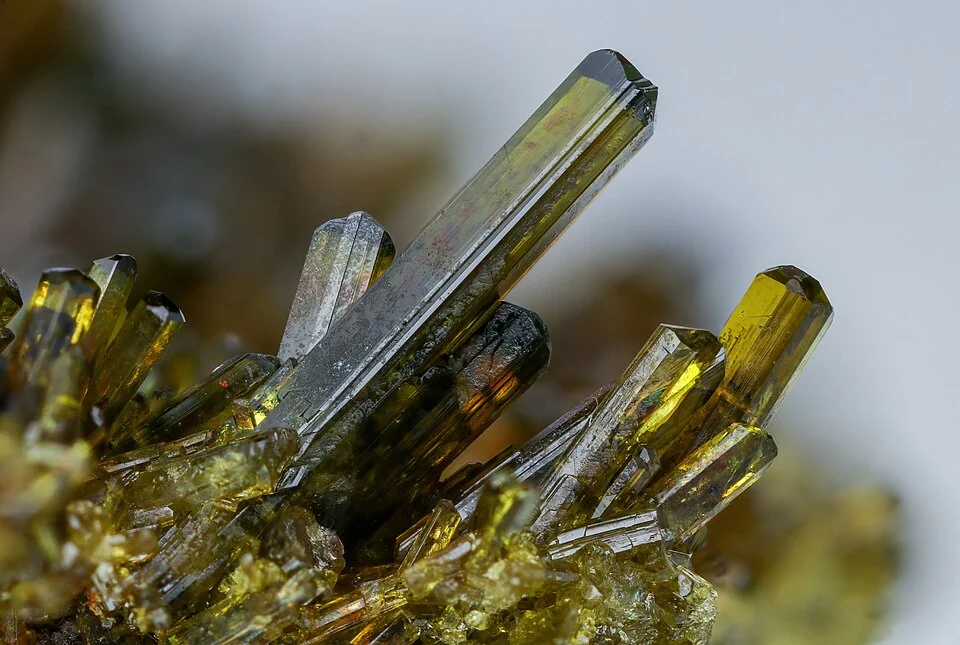
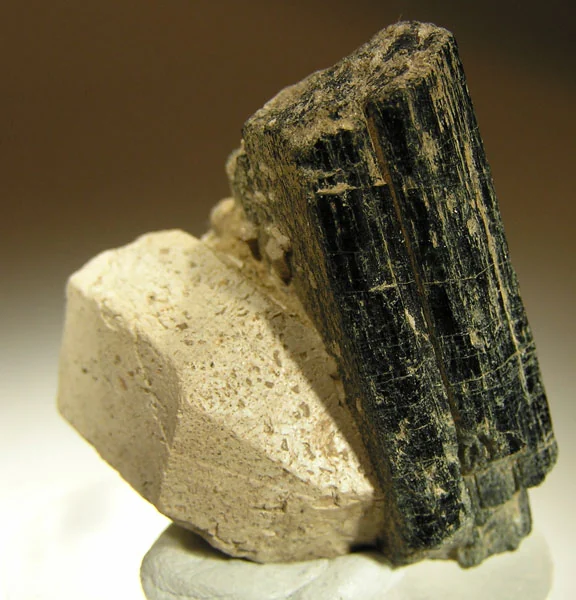
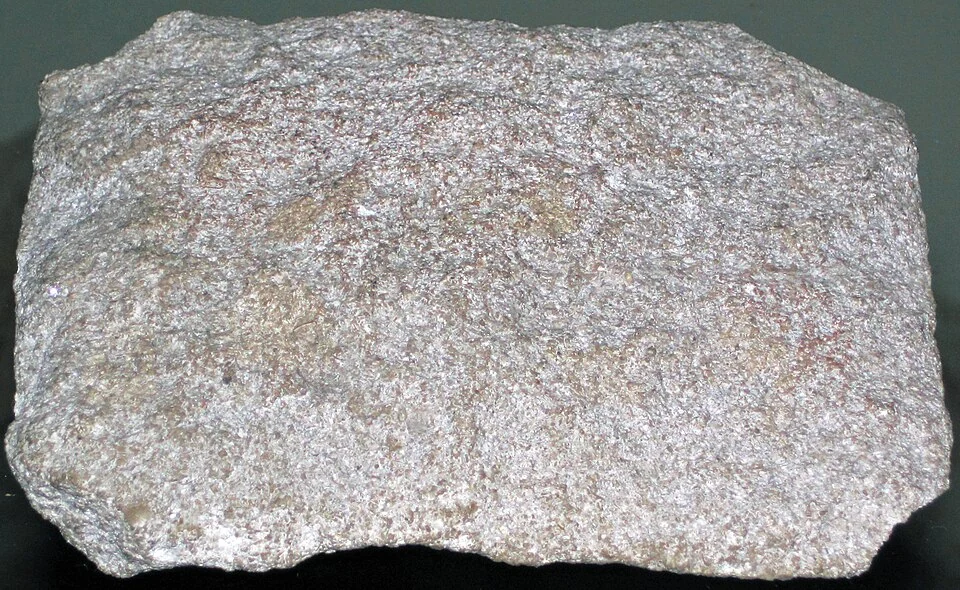
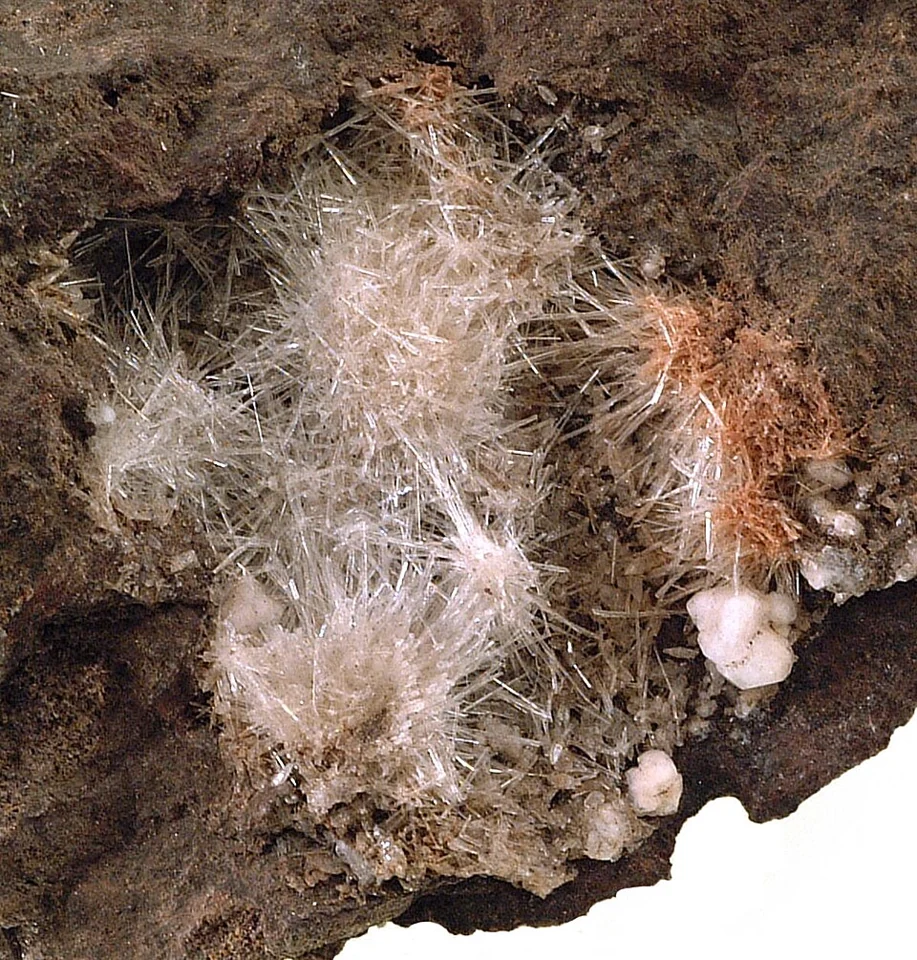
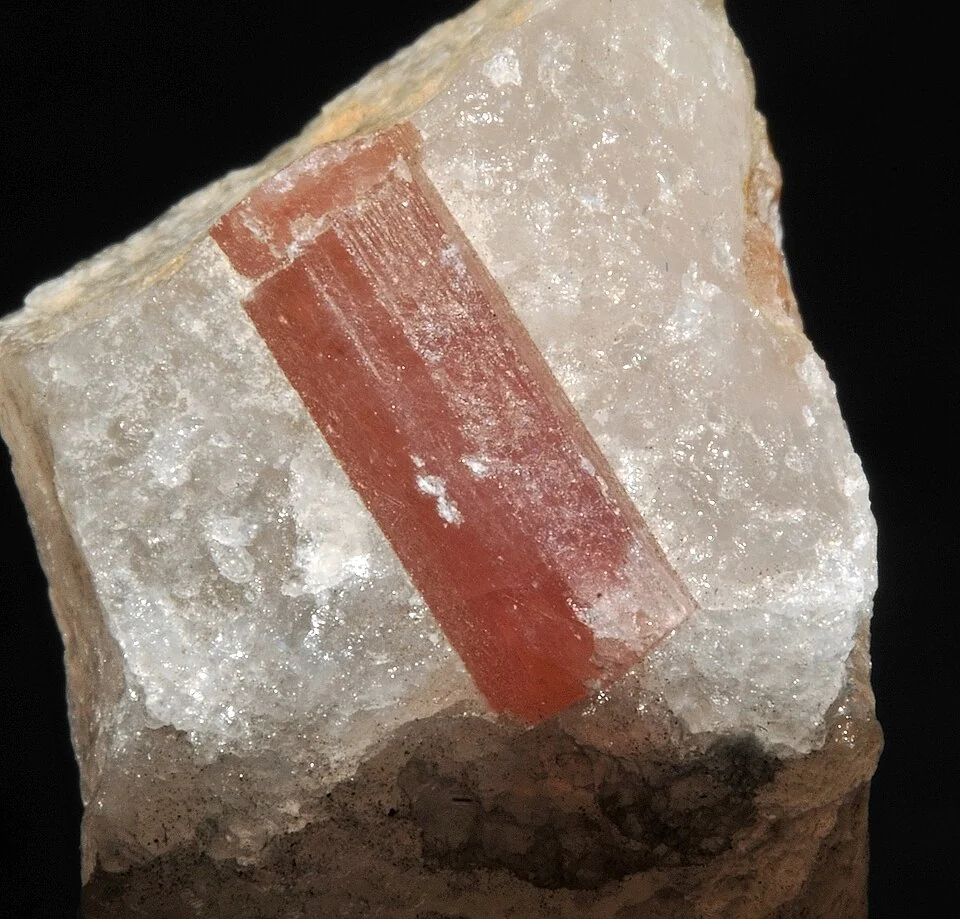
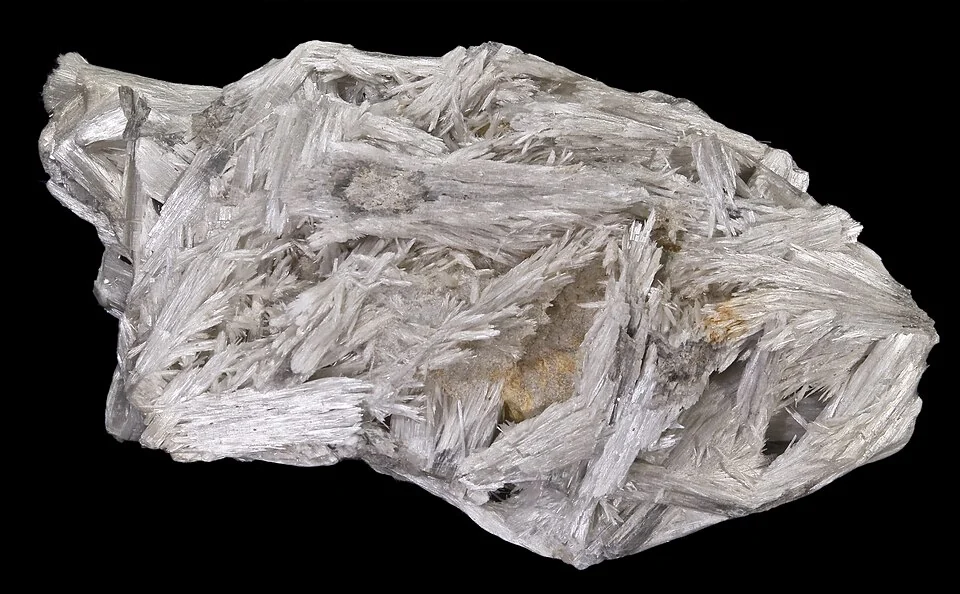
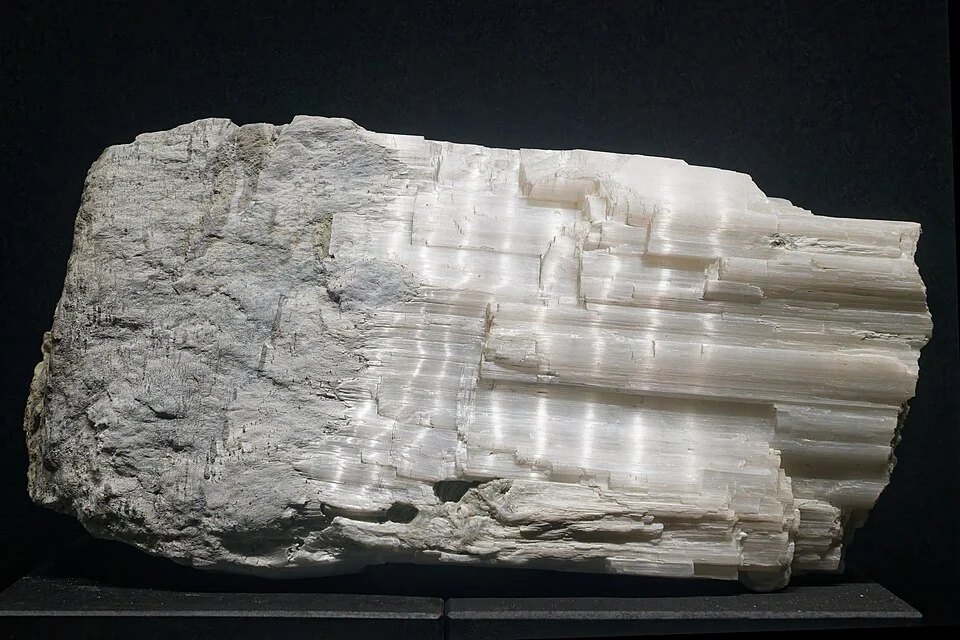
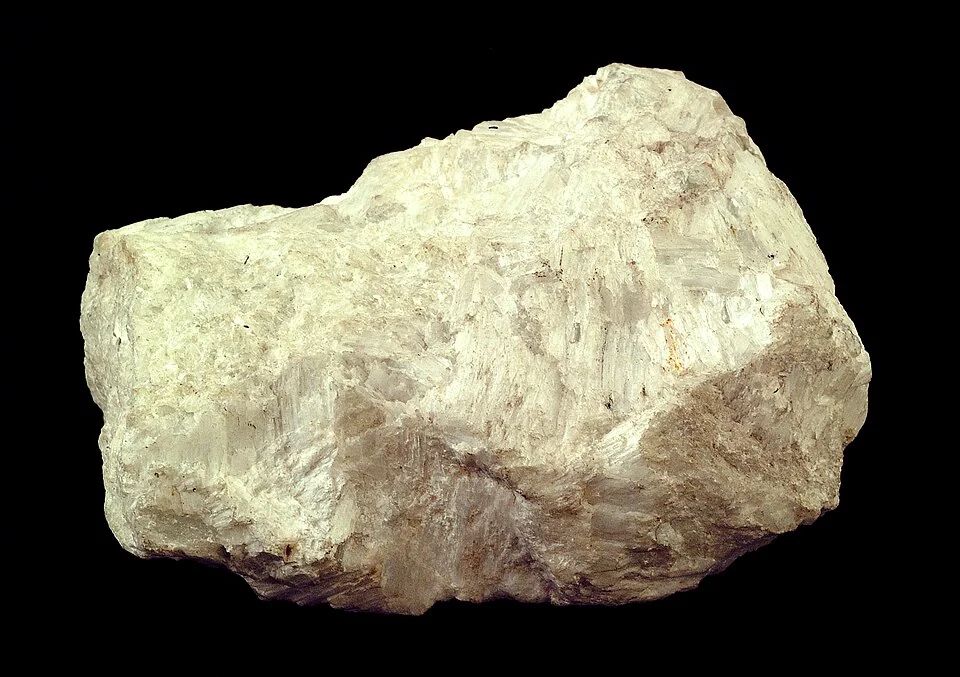
Actinolite specimen

Actinolite

Photographer / creator: Didier Descouens

License: CC BY-SA 4.0

Original: File:Actinolite Portugal.jpg

Resized to at most 960 pixels and converted to WebP; no cropping.

Source credit and review

Own work

Source description checked against the specimen; visual review confirms a usable crystal, aggregate or rock exposure without a specimen-name label.

Actinolite (acicular form) with calcite Locality : Montijos Quarry, Monte Redondo, Leiria, Leiria District, Portugal. Size 8x7.5 cm

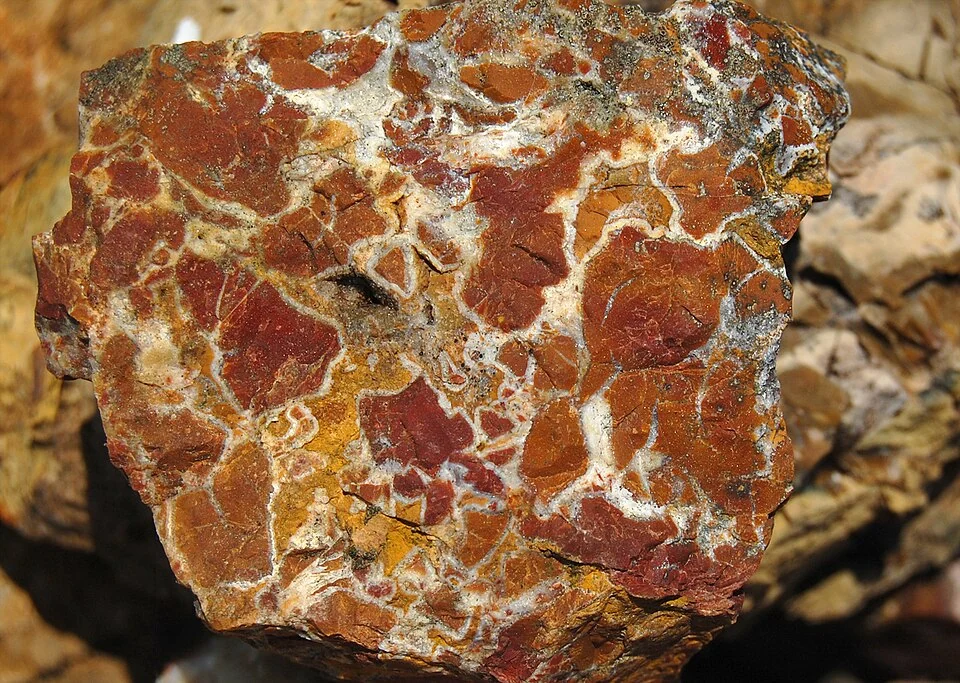
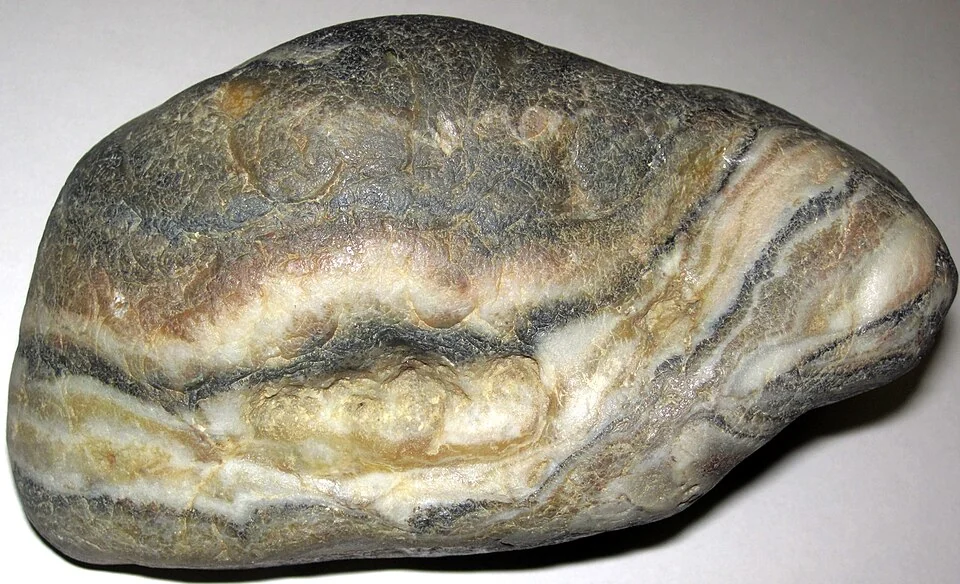
Agate/Chalcedony specimen

Agate/Chalcedony

Photographer / creator: James St. John

License: CC BY 2.0

Original: File:Banded chalcedony (Prairie Agate) (White River Badlands area, western South Dakota, USA) 4 (15688316692).jpg

Resized to at most 960 pixels and converted to WebP; no cropping.

Source credit and review

Banded chalcedony (Prairie Agate) (White River Badlands area, western South Dakota, USA) 4

Compared source description and visible specimen features; selected a representative crystal, aggregate or rock texture rather than an associated mineral or landscape.

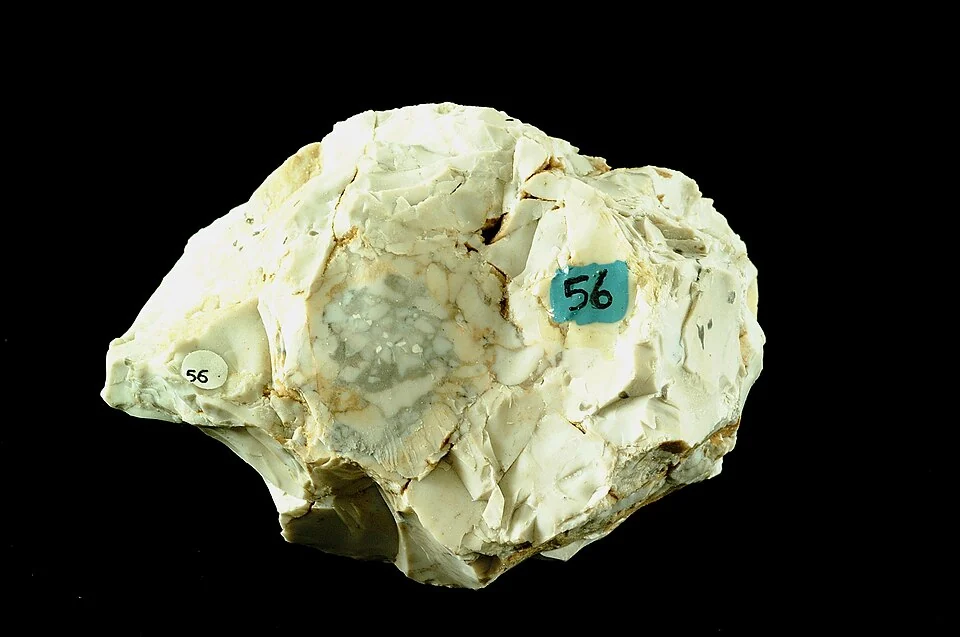
Banded chalcedony (agate) from South Dakota, USA (12.0 cm across at its widest). "Agate" is a rockhound/collector term for cavities in rocks (usually sedimentary rocks such as limestone or igneous rocks such as basalt) that have been partially or completely filled with irregularly concentric layers of microcrystalline, fibrous quartz (chalcedony - SiO2). Agate is quartz. This specimen is called "Prairie Agate". This material may ultimately be derived from agate-filled cavities in Pennsylvanian-aged carbonate sedimentary rocks (limestones) to the west of its collection locality (western South Dakota). Erosion of the original rocks resulted in an agate clast. This specimen may have spent some time in an Oligocene conglomerate in the Chadron Formation. Agate clasts in Chadron Formation conglomerates were liberated by erosion, resulting in surface and near-surface, loose clasts. Locality: White River Badlands area, western South Dakota, USA

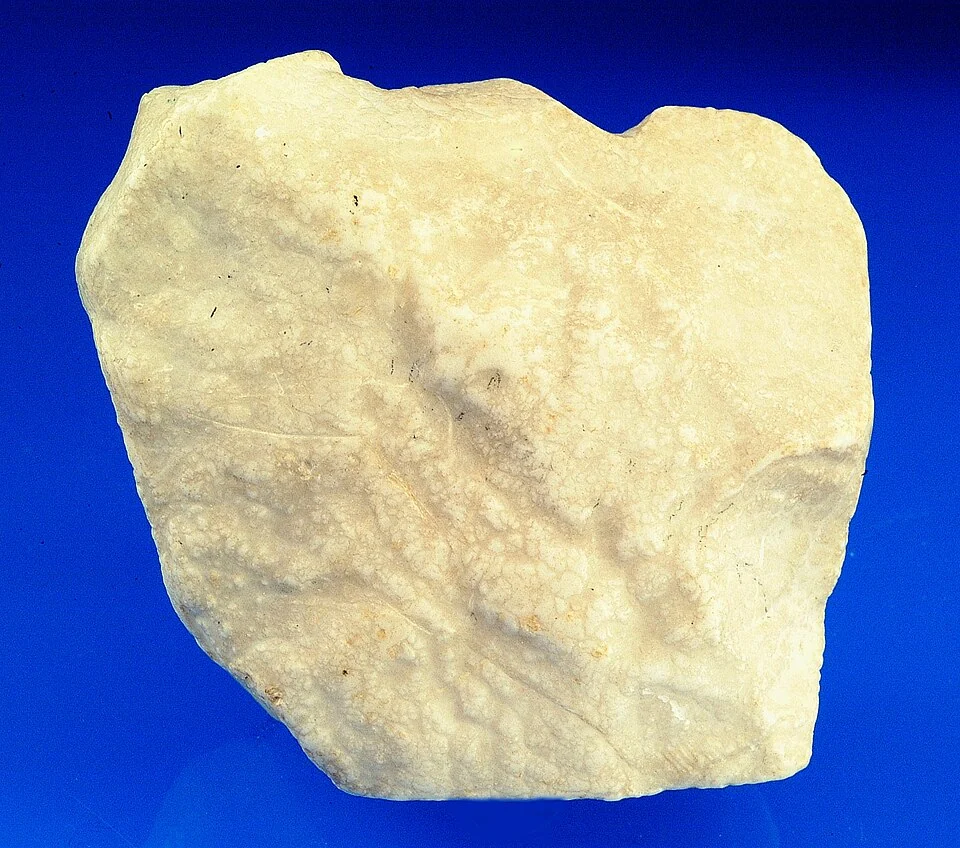
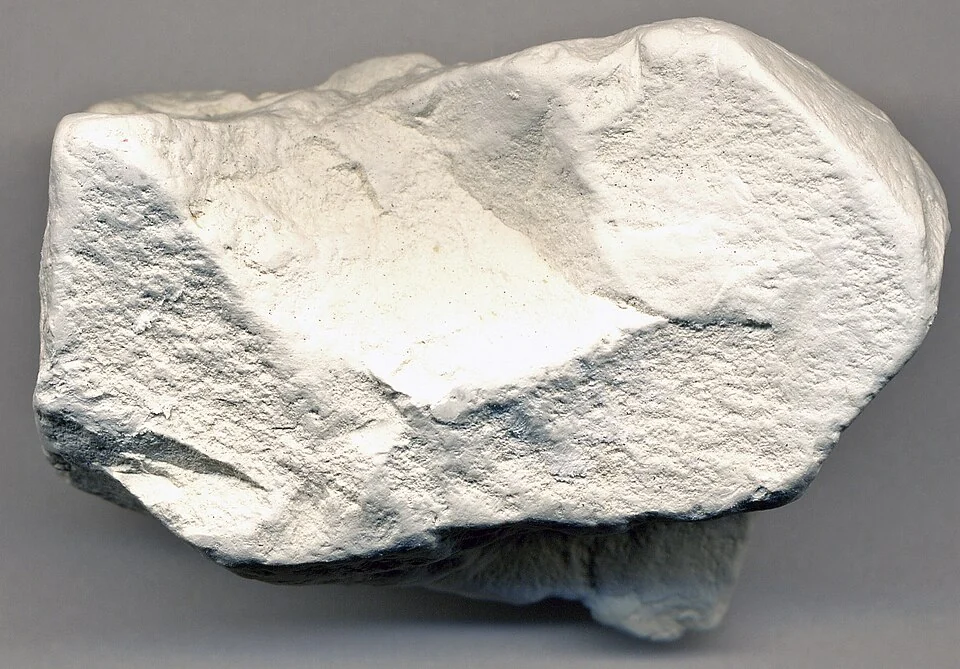
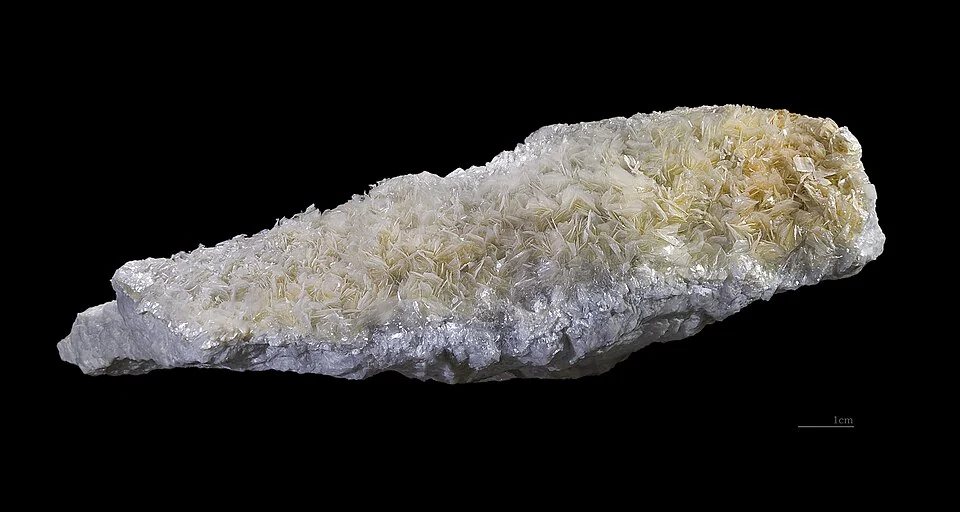
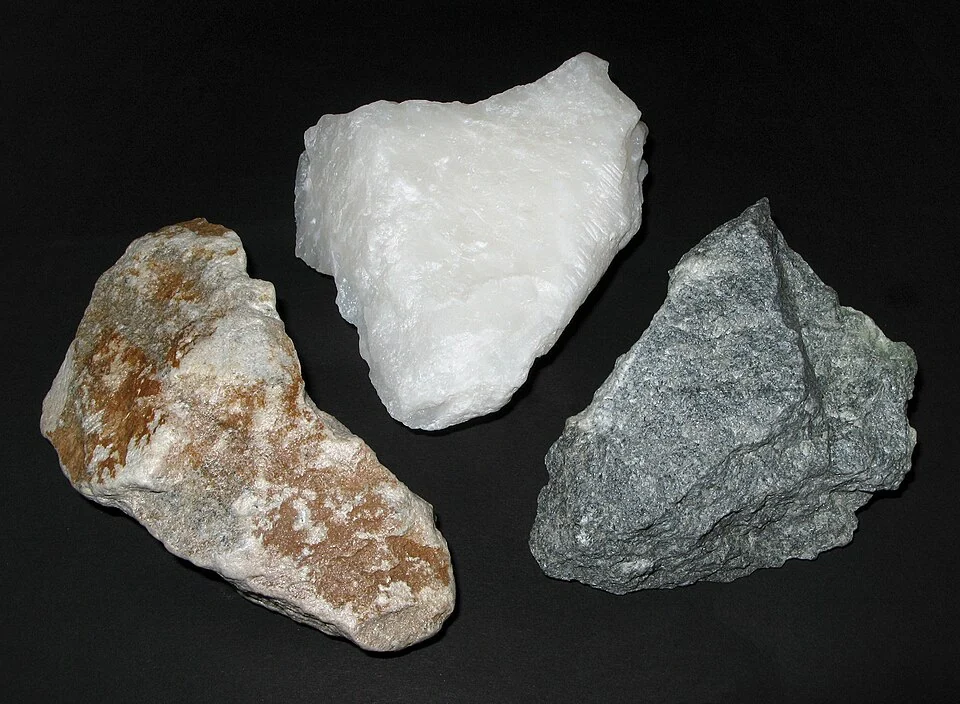
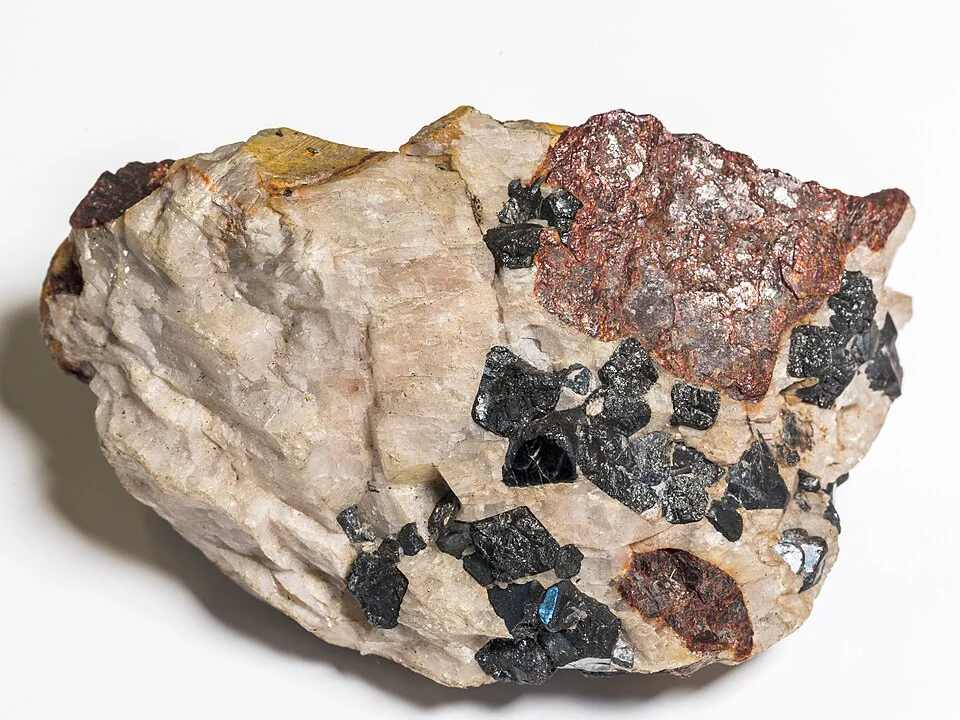
Alabaster specimen

Alabaster

Photographer / creator: Darla Sondrol

License: CC0

Original: File:Gypsum (alabaster) (GeoDIL number - 628).jpg

Resized to at most 960 pixels and converted to WebP; no cropping.

Source credit and review

https://geodil.dperkins.org/h/628.html

Source identity checked; selected for visible cleavage, foliation, massive texture or tabular crystal habit. No specimen-name label is visible.

Gypsum has many different appearances. Often it is massive and fine grained, and we call it alabaster. Fibrous varieties are called satin spar. Coarser, clear bladed varieties are called selenite. This sample of alabaster is about 10.5 cm across.

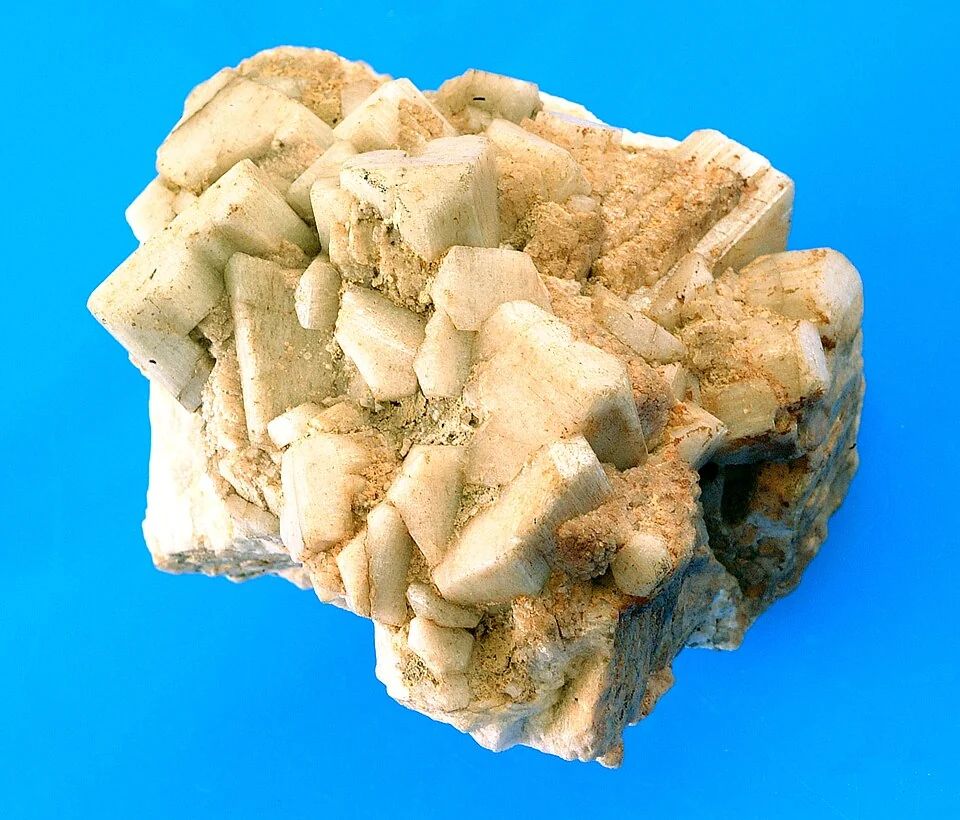
Albite specimen

Albite

Photographer / creator: Shannon Heinle

License: CC0

Original: File:Albite (GeoDIL number - 2917).jpg

Resized to at most 960 pixels and converted to WebP; no cropping.

Source credit and review

https://geodil.dperkins.org/h/2917.html

Compared source description and visible specimen features; selected a representative crystal, aggregate or rock texture rather than an associated mineral or landscape.

Albite is a common felspar and is the “pivot” mineral of two different feldspar series. Albite is the last of the feldspars to crystallize from molten rock. All plagioclase feldspars show a type of twinning that is named after albite. Albite's chemical formula is NaAlSi3O8. The name comes from the Latin, albus, in allusion to the common color.

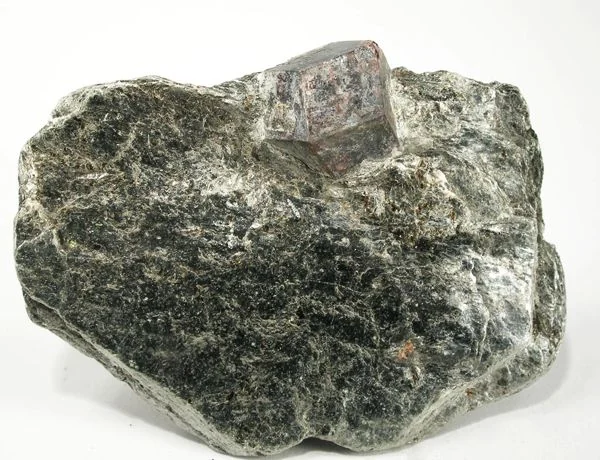
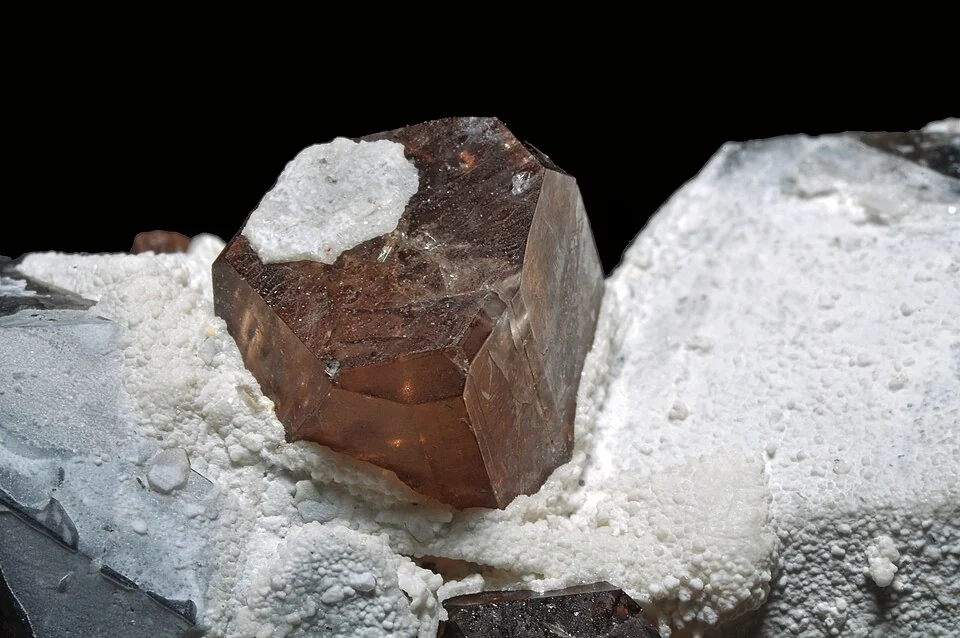
Almandine specimen

Almandine

Photographer / creator: Rob Lavinsky, iRocks.com – CC-BY-SA-3.0 · iRocks.com

License: CC BY-SA 3.0

Original: File:Almandine-267190.jpg

Resized to at most 960 pixels and converted to WebP; no cropping.

Source credit and review

http://www.mindat.org/photo-267190.html

Compared source description and visible specimen features; selected a representative crystal, aggregate or rock texture rather than an associated mineral or landscape.

Almandine Locality: Bodø , Nordland , Norway ( Locality at mindat.org ) Size: 8.1 x 5.8 x 2.1 cm. A sharp, lustrous, wine-red almandine garnet crystal with gemmy highlights aesthetically straddles the edge of waxy lustre plates of greenish-black chlorite schist. The textbook, dodecahedral crystal is 1.9 cm. Classic, old-time material from the Mullane Collection and comes with an Anton Berger label, well-known Austrian mineral dealers from the 1920s-1950s. The label has a December, 1952 date on it.

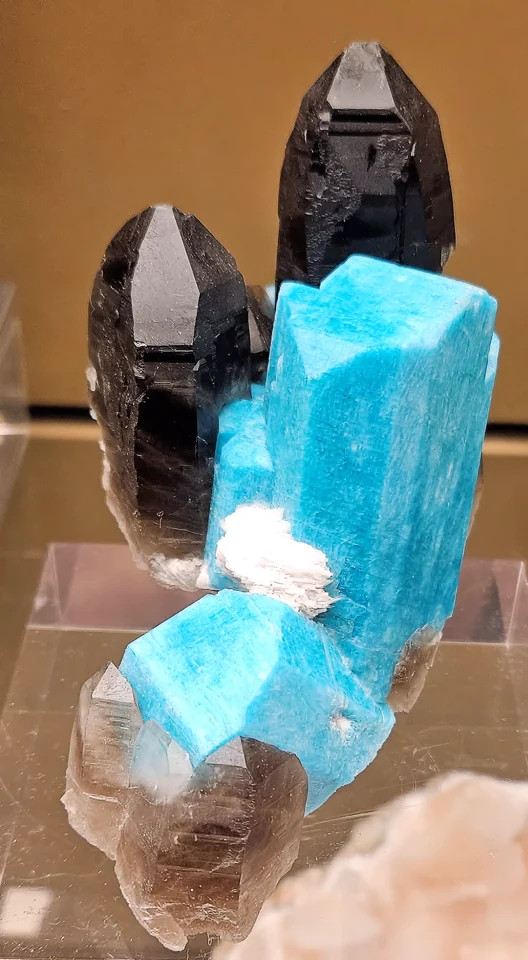
Amazonite specimen

Amazonite

Photographer / creator: Eric Polk

License: CC BY-SA 4.0

Original: File:Amazonite with Smoky Quartz NHMLA.png

Resized to at most 960 pixels and converted to WebP; no cropping.

Source credit and review

Own work

Compared source description and visible specimen features; selected a representative crystal, aggregate or rock texture rather than an associated mineral or landscape.

Sample of Amazonite with Smoky Quartz collected from Two Point Mine, Teller County, Colorado, USA. On display at the Natural History Museum of Los Angeles County, Los Angeles, California, USA.

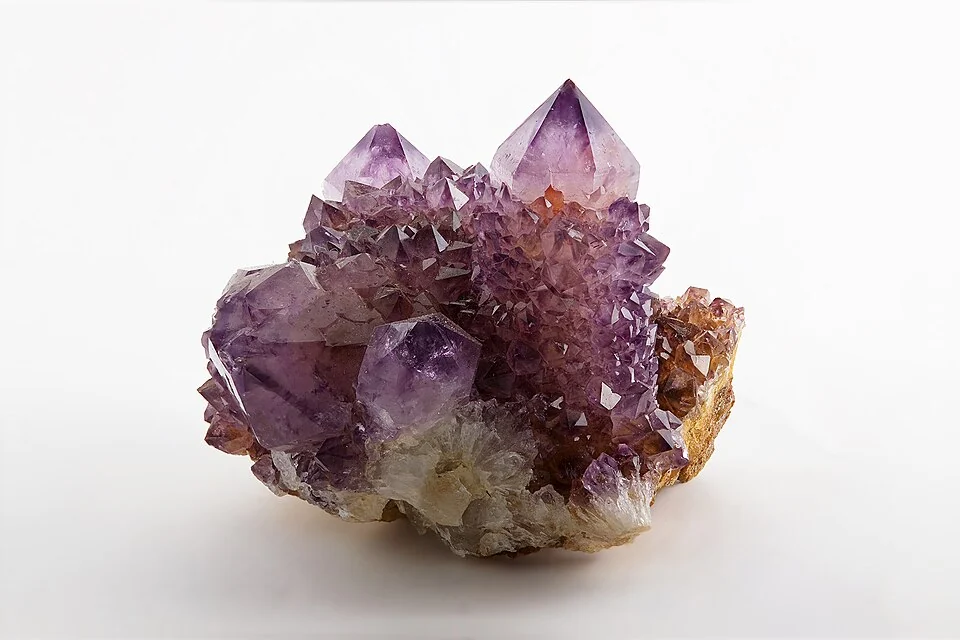
Amethyst specimen

Amethyst

Photographer / creator: JJ Harrison ( https://jjharrison.com.au/ )

License: CC BY-SA 3.0

Original: File:Amethyst. Magaliesburg, South Africa.jpg

Resized to at most 960 pixels and converted to WebP; no cropping.

Source credit and review

Own work

Compared source description and visible specimen features; selected a representative crystal, aggregate or rock texture rather than an associated mineral or landscape.

Amethyst specimen from Magaliesburg, South Africa.

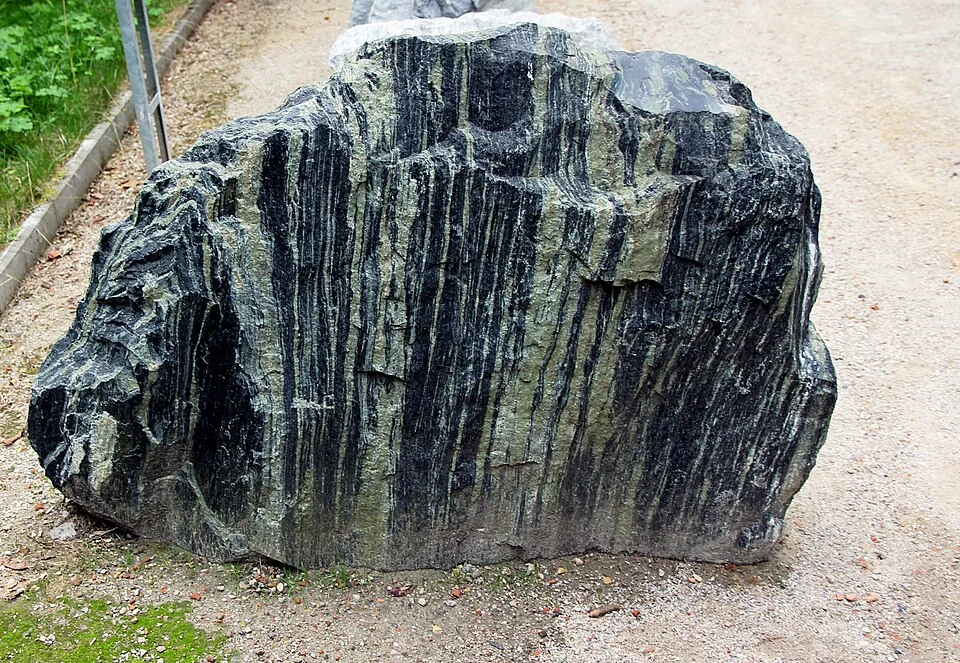
Amphibolite specimen

Amphibolite

Photographer / creator: Karelj

License: CC BY-SA 3.0

Original: File:Amphibolite Geopark Prague 2014 1.jpg

Resized to at most 960 pixels and converted to WebP; no cropping.

Source credit and review

Own work

Source description checked against the specimen; visual review confirms a usable crystal, aggregate or rock exposure without a specimen-name label.

Rock Amphibolite from Geopark in the Botanical Gardens of Charles University , Prague , Czech Republic

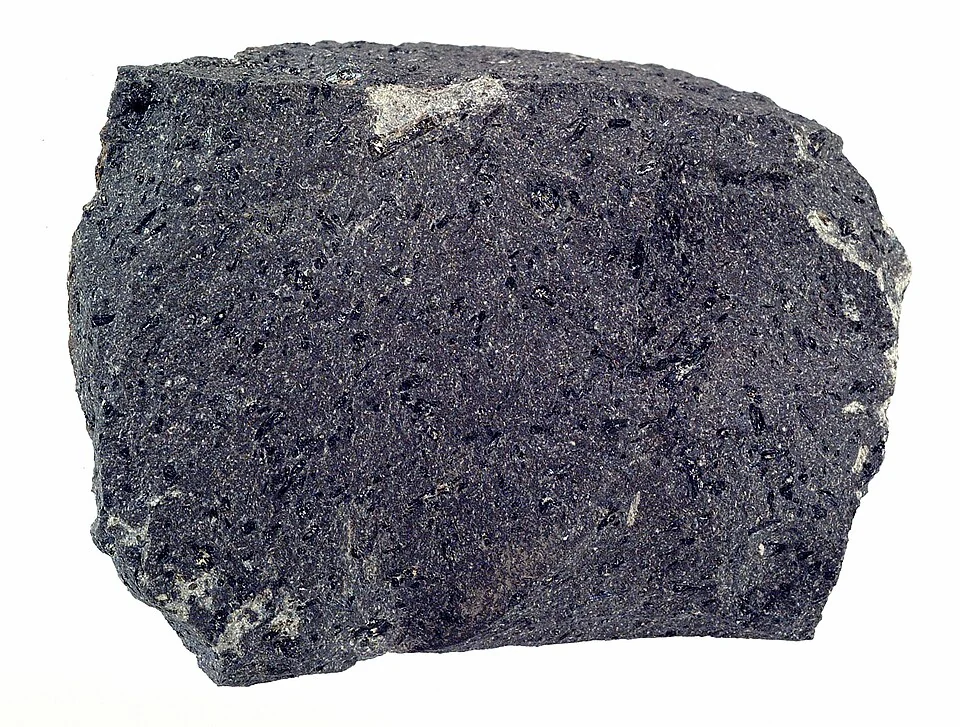
Andesite specimen

Andesite

Photographer / creator: Twyla Baker

License: CC0

Original: File:Hornblende andesite (GeoDIL number - 91).jpg

Resized to at most 960 pixels and converted to WebP; no cropping.

Source credit and review

https://geodil.dperkins.org/h/91.html

Source description checked against the rock type; selected for visible hand-specimen texture. Museum inventory numbers are not identification labels.

This andesite is an extrusive igneous rock with black hornblende crystals in a light-gray groundmass. The fine grained matrix is composed of plagioclase micro-crystals, very small prisms of clinopyroxene and dots of magnetite. This sample is about 10 cm across.

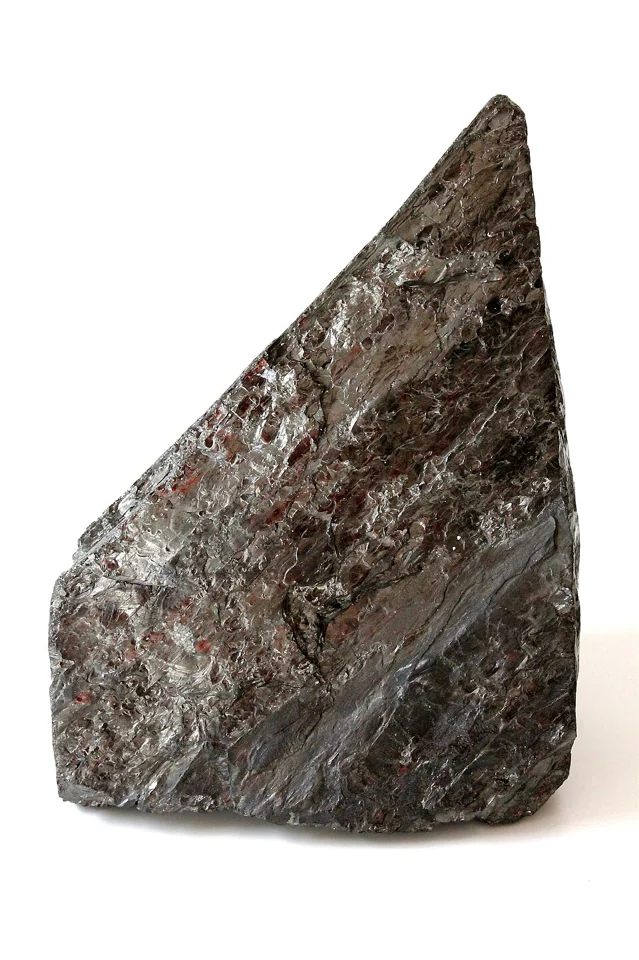
Anthracite specimen

Anthracite

Photographer / creator: Jakec

License: CC BY-SA 4.0

Original: File:Anthracite chunk.JPG

Resized to at most 960 pixels and converted to WebP; no cropping.

Source credit and review

Own work

Source description and visible appearance reviewed for specimen identity, diagnostic texture or crystal habit. Selected photo has no visible specimen-name label.

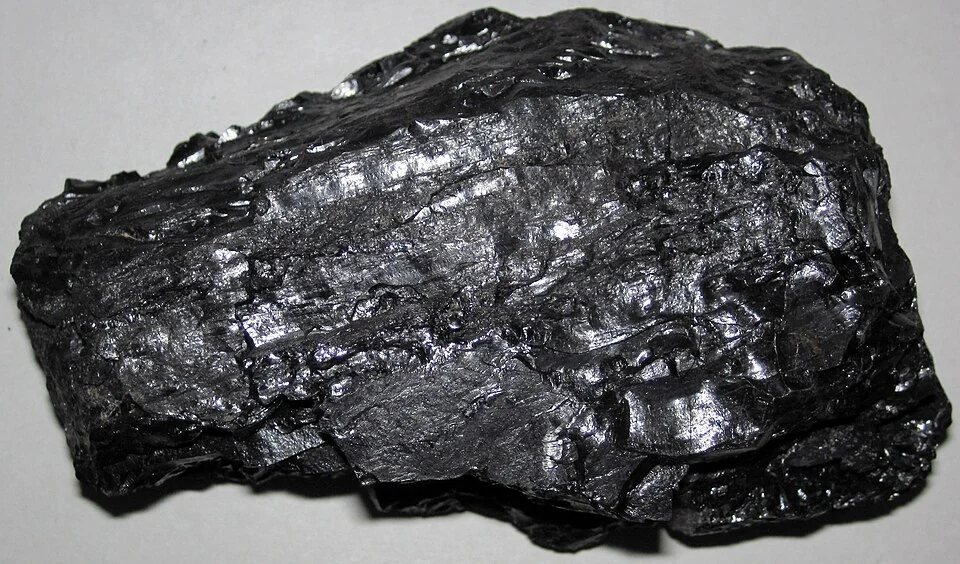
A large chunk of anthracite coal measuring roughly 10 inches by 7 inches by 5 inches

Apophyllite specimen

Apophyllite

Photographer / creator: Nessa Eull

License: CC0

Original: File:Apophyllite (GeoDIL number - 2259).jpg

Resized to at most 960 pixels and converted to WebP; no cropping.

Source credit and review

https://geodil.dperkins.org/h/2259.html

Visual appearance and source description reviewed for the named mineral, variety or rock. Selected for visible diagnostic features; no specimen-name label is visible.

Apophyllite, KCa4Si8O20(F,OH)8·H2O, is the official name for three white to grayish tetragonal minerals with a pearly to vitreous luster, having a specific gravity of 2.3 to 2.4 and a hardness of 4.5 to 5 on the Mohs scale. These minerals are fluorapophyllite, hydroxyapophyllite, and natroapophyllite. Fluorapophyllite is by far the most abundant and colorful of the three and is usually what is referred to when a specimen is just labeled apophyllite. Apophyllite occurs with zeolites in amygdules in basalts and other igneous rocks. Apophyllite is also found in the voids in the contact metamorphic zone limestones that surround intrusive rocks. This sample contains large euhedral apophyllite (left end) in a sea of smaller apophyllite crystals. It is about 12 cm across. Apophyllite is named from the Greek apophylliso meaning “it flakes off”.

Aragonite specimen

Aragonite

Photographer / creator: Ivar Leidus

License: CC BY-SA 4.0

Original: File:Aragonite - Pantoja, Toledo, Castile-La Mancha, Spain.jpg

Resized to at most 960 pixels and converted to WebP; no cropping.

Source credit and review

Own work

Compared source description and visible specimen features; selected a representative crystal, aggregate or rock texture rather than an associated mineral or landscape.

Aragonite crystal cluster (3 × 2.2 × 1.8 cm). Found from Pantoja, Toledo, Castile-La Mancha, Spain

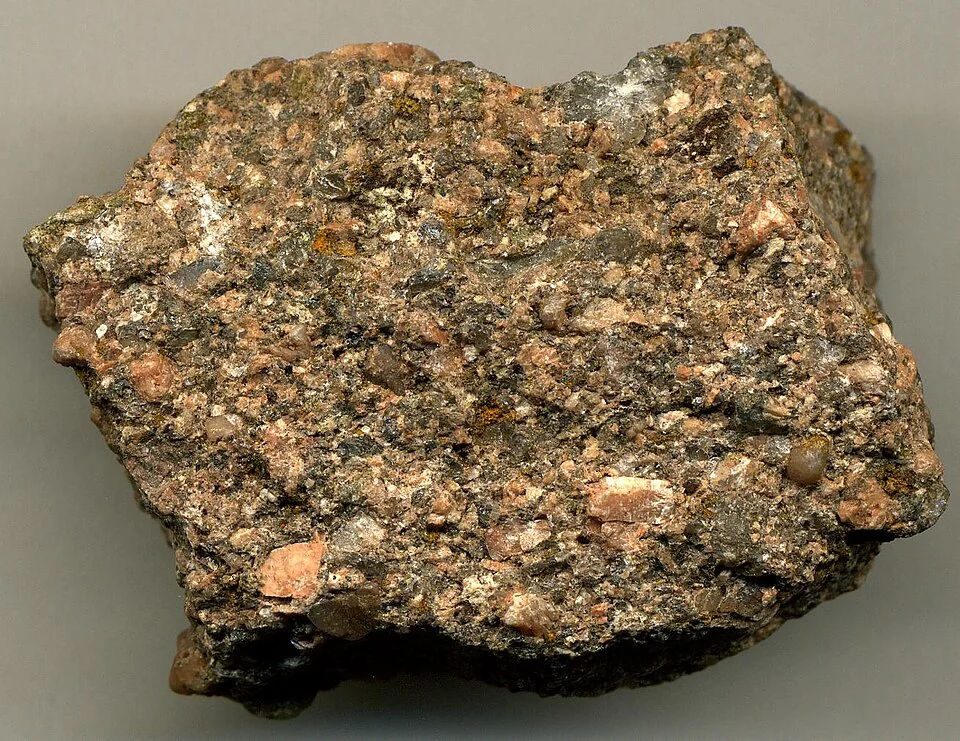
Arkose specimen

Arkose

Photographer / creator: James St. John

License: CC BY 2.0

Original: File:Arkose with K-feldspar (pinkish-orangish) and quartz (gray) grains.jpg

Resized to at most 960 pixels and converted to WebP; no cropping.

Source credit and review

Arkose with K-feldspar (pinkish-orangish) and quartz (gray) grains.

Source description and visible appearance reviewed for specimen identity, diagnostic texture or crystal habit. Selected photo has no visible specimen-name label.

Arkose with K-feldspar (pinkish-orangish) and quartz (gray) grains.

Augite specimen

Augite

Photographer / creator: Shannon Heinle

License: CC0

Original: File:Augite (GeoDIL number - 403).jpg

Resized to at most 960 pixels and converted to WebP; no cropping.

Source credit and review

https://geodil.dperkins.org/h/403.html

Compared source description and visible specimen features; selected a representative crystal, aggregate or rock texture rather than an associated mineral or landscape.

This sample of augite from Eganville, Ontario, Canada is about 4.5 cm across. Augite is a clinopyroxene of complex chemistry, having the general formula (Ca,Na)(Mg,Fe,Al)(Al,Si)2O6. It is an important rock forming mineral in many gabbros and basalts and in some metamorphic rocks.

Aventurine specimen

Aventurine

Photographer / creator: Darla Sondrol

License: CC0

Original: File:Quartz, aventurine (GeoDIL number - 2517).jpg

Resized to at most 960 pixels and converted to WebP; no cropping.

Source credit and review

https://geodil.dperkins.org/h/2517.html

Compared source description and visible specimen features; selected a representative crystal, aggregate or rock texture rather than an associated mineral or landscape.

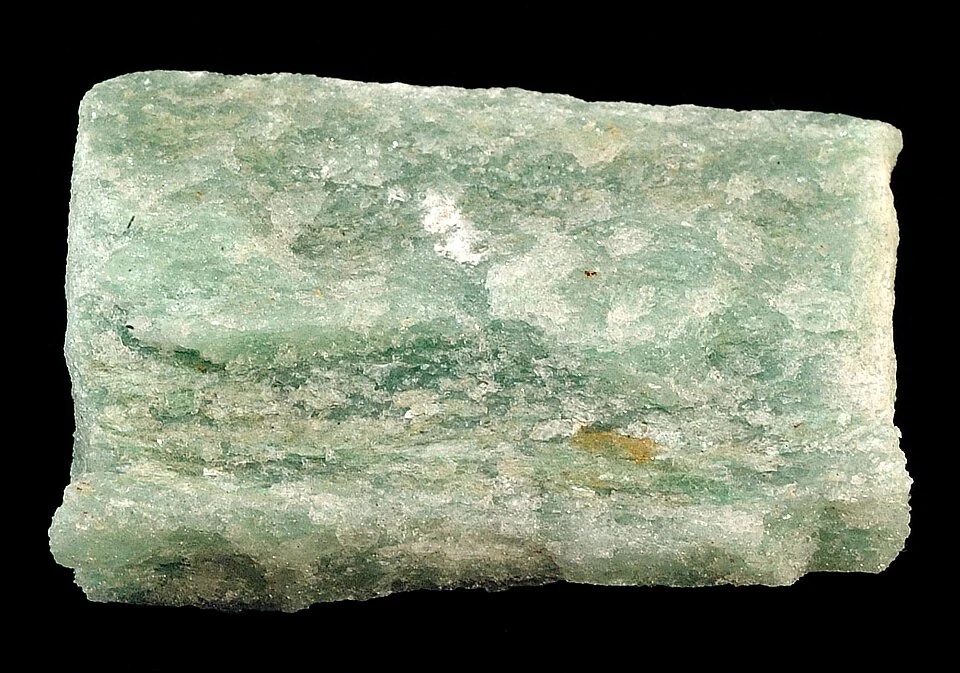
Aventurine is a green chalcedony (variety of quartz, SiO2) that contains small inclusions of one of several shiny minerals that give the stone a glistening effect. The glistening effect of aventurine is known as aventurescence. The color of the aventurescence depends on the mineral included in the stone.

Azurite specimen

Azurite

Photographer / creator: Ivar Leidus

License: CC BY-SA 4.0

Original: File:Azurite - New Nevada Lode, La Sal, Utah, USA.jpg

Resized to at most 960 pixels and converted to WebP; no cropping.

Source credit and review

Own work

Compared source description and visible specimen features; selected a representative crystal, aggregate or rock texture rather than an associated mineral or landscape.

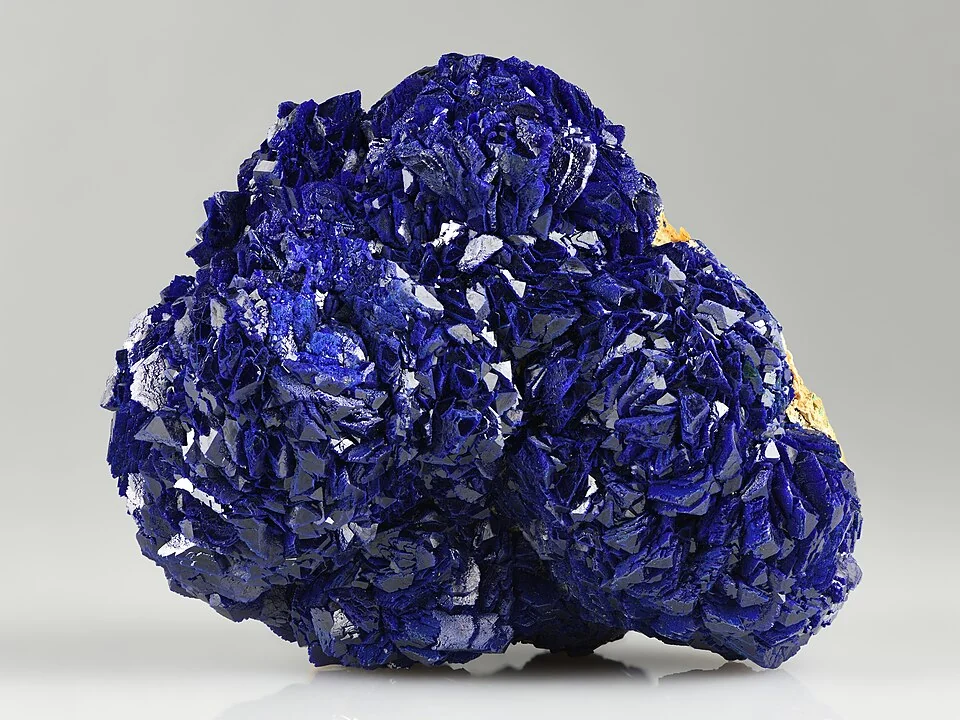
Blue crystals of azurite covering matrix (4.0 × 3.0 × 2.0 cm) with minor malachite. Found from New Nevada Lode, La Sal, Utah, USA

Banded Iron Formation specimen

Banded Iron Formation

Photographer / creator: Graeme Churchard from Bristol, UK

License: CC BY 2.0

Original: File:Banded iron formation Dales Gorge.jpg

Resized to at most 960 pixels and converted to WebP; no cropping.

Source credit and review

Dales Gorge Uploaded by PDTillman

Source description and visible appearance reviewed for specimen identity, diagnostic texture or crystal habit. Selected photo has no visible specimen-name label.

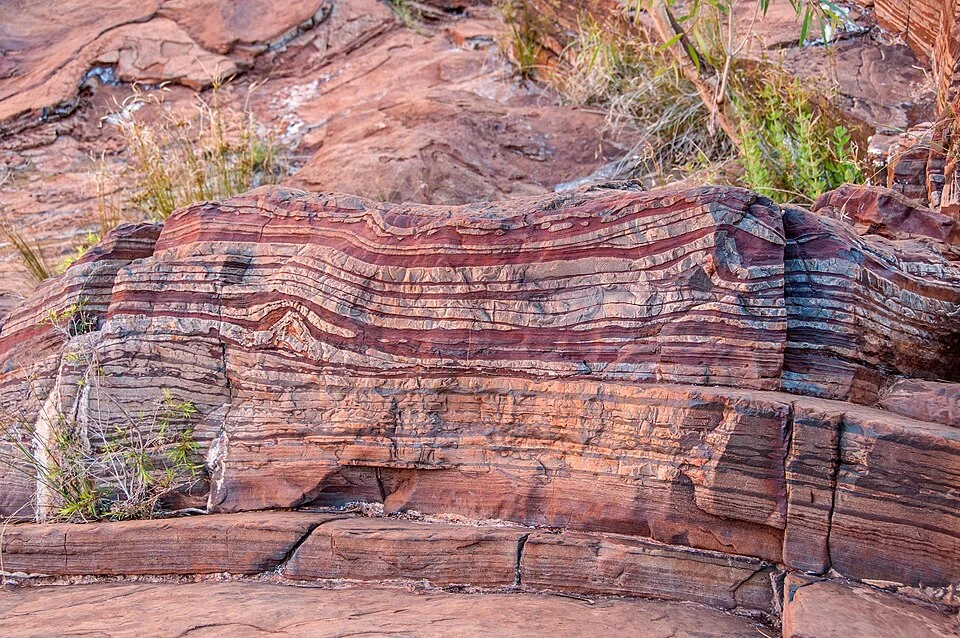
Banded Iron Formation at the Fortescue Falls

Barite specimen

Barite

Photographer / creator: Ivar Leidus

License: CC BY-SA 4.0

Original: File:Barite - Cerro Warihuyn, Miraflores, Huamalies, Huanuco, Peru.jpg

Resized to at most 960 pixels and converted to WebP; no cropping.

Source credit and review

Own work

Source identity checked; selected for visible cleavage, foliation, massive texture or tabular crystal habit. No specimen-name label is visible.

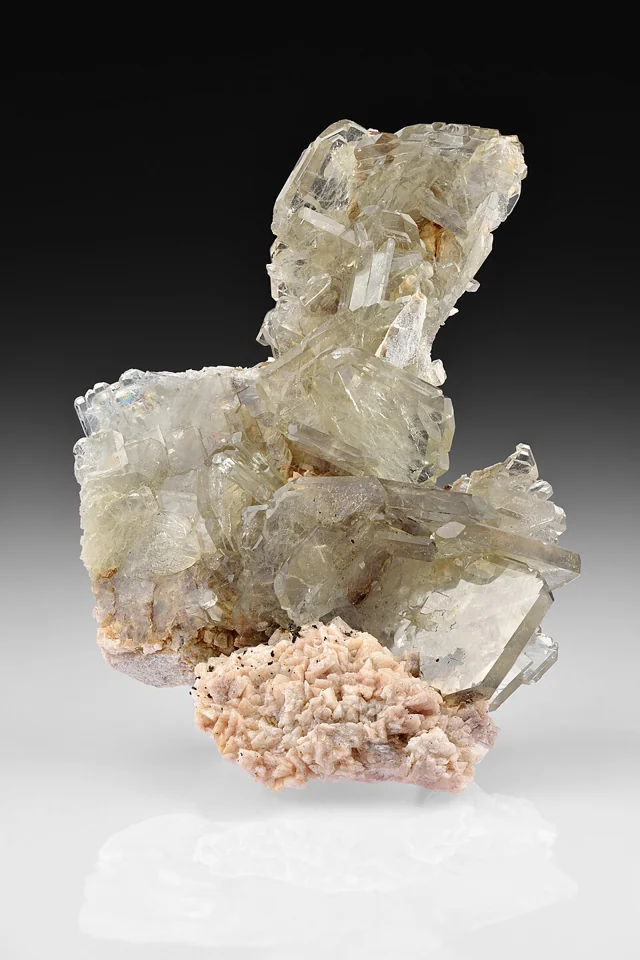
Crystals of barite on a dolomite crystal matrix (6.0 × 4.0 × 1.5 cm). Found from Cerro Warihuyn, Miraflores, Huamalies, Huanuco, Peru.

Basalt specimen

Basalt

Photographer / creator: Nessa Eull

License: CC0

Original: File:Basalt (GeoDIL number - 455).jpg

Resized to at most 960 pixels and converted to WebP; no cropping.

Source credit and review

https://geodil.dperkins.org/h/455.html

Source description checked against the rock type; selected for visible hand-specimen texture. Museum inventory numbers are not identification labels.

This is a typical basalt: dark colored and fine grained. The minerals present cannot be identified by looking at this hand specimen. Geologists use a sort of deductive reasoning: they know what minerals are present because they can identify this as a basalt. Even using a microscope, minerals are hard to identify. Most of this rock is exceptionally fine grained but it does contain a few coarser lathes of plagioclase and clinopyroxene.

Bauxite specimen

Bauxite

Photographer / creator: saphon

License: CC BY-SA 1.0

Original: File:Bauxite hérault.JPG

Resized to at most 960 pixels and converted to WebP; no cropping.

Source credit and review

Own work

Source description and visible appearance reviewed for specimen identity, diagnostic texture or crystal habit. Selected photo has no visible specimen-name label.

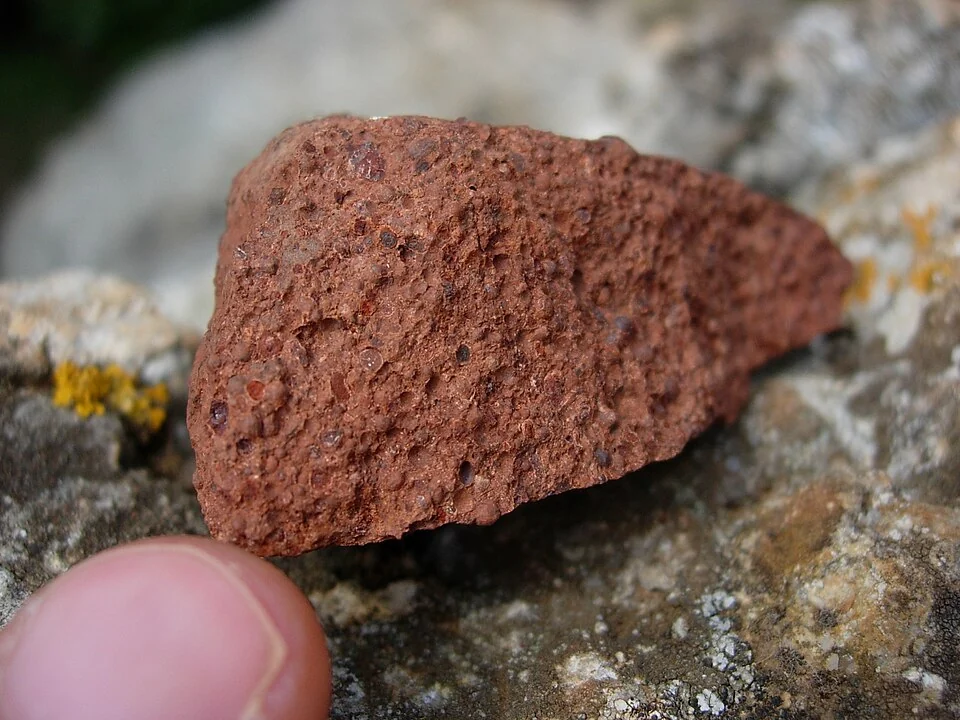
bauxite (hérault)

Beryl specimen

Beryl

Photographer / creator: Reno Chris at English Wikipedia

License: Public domain

Original: File:Beryl09.jpg

Resized to at most 960 pixels and converted to WebP; no cropping.

Source credit and review

Transferred from en.wikipedia to Commons.

Visual appearance and source description reviewed for the named mineral, variety or rock. Selected for visible diagnostic features; no specimen-name label is visible.

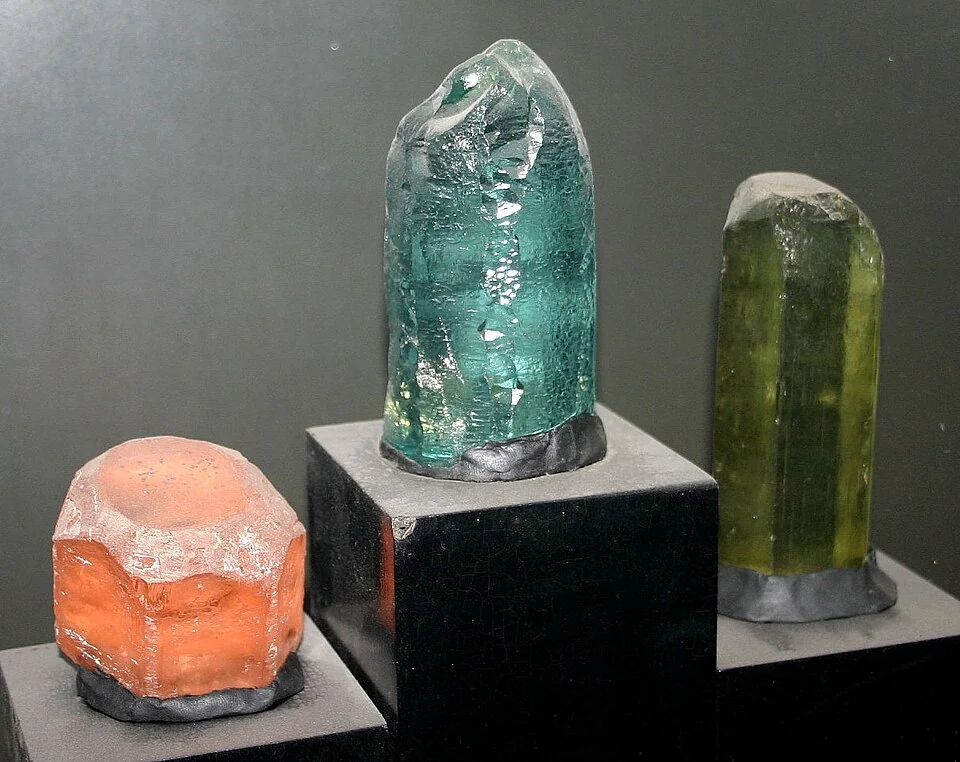
Source: Chris Ralph. This photo taken by Chris Ralph of Nevada-outback-gems.com [1] , Photographer and author: photo taken by author.

Biotite specimen

Biotite

Photographer / creator: Fred Kruijen

License: CC BY-SA 3.0 nl

Original: File:Biotite aggregate - Ochtendung, Eifel, Germany.jpg

Resized to at most 960 pixels and converted to WebP; no cropping.

Source credit and review

https://www.strahlen.org/archive/wannenkopfe/biotite16.html

Source description and visible appearance reviewed for specimen identity, diagnostic texture or crystal habit. Selected photo has no visible specimen-name label.

Biotite aggregate (Image width: 2,5 mm) - Locality: Wannenköpfe, Ochtendung, Eifel region, Germany

Bituminous specimen

Bituminous

Photographer / creator: James St. John

License: CC BY 2.0

Original: File:Bituminous coal (Ferron Sandstone Member, Mancos Shale, Upper Cretaceous; Bronco Mine, Emery County, Utah, USA) 17.jpg

Resized to at most 960 pixels and converted to WebP; no cropping.

Source credit and review

https://www.flickr.com/photos/47445767@N05/51918767271/

Visual appearance and source description reviewed for the named mineral, variety or rock. Selected for visible diagnostic features; no specimen-name label is visible.

Bituminous coal from the Cretaceous of Utah, USA. Coal is a carbon-rich, biogenic sedimentary rock. It forms by the burial and alteration of organic matter from fossil land plants that lived in ancient swamps. Coal starts out as peat. With increasing burial and diagenetic alteration, peat becomes lignite coal, sub-bituminous coal, and then bituminous coal. Bituminous coals tend to break and weather in a blocky fashion, are relatively sooty to the touch, and are harder and heavier than lignite coal (but still relatively soft and lightweight). Discernible plant fossil fragments may be present on bituminous coal bedding planes - sometimes in abundance. Bituminous coals commonly have irregular patches of shiny, glassy-textured organic matter (vitrain). Info. from public signage at Wittenberg University's Geology Department (Springfield, Ohio, USA): Origin of Coal Coal is formed from accumulated vegetation that grew in peat-forming swamps on broad lowlands that were near sea level. Cyclothems indicate that the land must have been at a "critical level" since the change from marine to non-marine sediments shows that the seas periodically encroached upon the land. Formation of Coal The change from plant debris to coal involves biochemical action producing partial decay, preserval of this material from further decay, and later dynamochemical processes. The biochemical changes involve attack by bacteria which liberate volatile constituents, and the preserval of the residual waxes and resins in the bottom of the swamps where the water is too toxic for the decay-promoting bacteria to live. The accumulated material forms "peat bogs". The dynamochemical process involves further chemical reactions produced by the increased pressure and temperature brought about by the weight of sediment that is deposited on top of it. These reactions are also ones in which the volatile constituents are driven off. Rank of Coal The different types of coal are commonly referred to in terms of rank. From lowest upward, they are peat (actually not a coal), lignite, bituminous, and anthracite. The rank of the coal is the result of the different amounts of pressure and time involved in producing the coal. Bituminous Bituminous coal is a dense, dark, brittle, banded coal that is well jointed and breaks into cubical or prismatic blocks and does not disintegrate upon exposure to air. Dull and bright bands and smooth and hackly layers are evident. It ignites easily, burns with a smoky yellow flame, has low moisture contnet, medium volatile content, and fixed carbon and heating content is high. It is the most used and most desired coal in the world for industrial uses. In the United States, the Northern Appalachian fields lead in production, followed by the interior fields of the Midwest. This sample comes from Utah's Bronco Mine, which reportedly started in the 1880s. The coal ranks as high-volatile C bituminous coal, which means it gives off less heat than high-volatile A or B bituminous coals. The former gives off about 11,500 British thermal units (Btu) of heat per pound of coal. The latter two give off about 14,000 and 13,000 Btu per pound, respectively. Stratigraphy: coal horizon in the Ferron Sandstone Member, Mancos Shale, Upper Cretaceous Locality: Bronco Mine (= Emery Deep Mine), Emery County, central Utah, USA

Bornite specimen

Bornite

Photographer / creator: Darla Sondrol

License: CC0

Original: File:Bornite (GeoDIL number - 1129).jpg

Resized to at most 960 pixels and converted to WebP; no cropping.

Source credit and review

https://geodil.dperkins.org/h/1129.html

Visual appearance and source description reviewed for the named mineral, variety or rock. Selected for visible diagnostic features; no specimen-name label is visible.

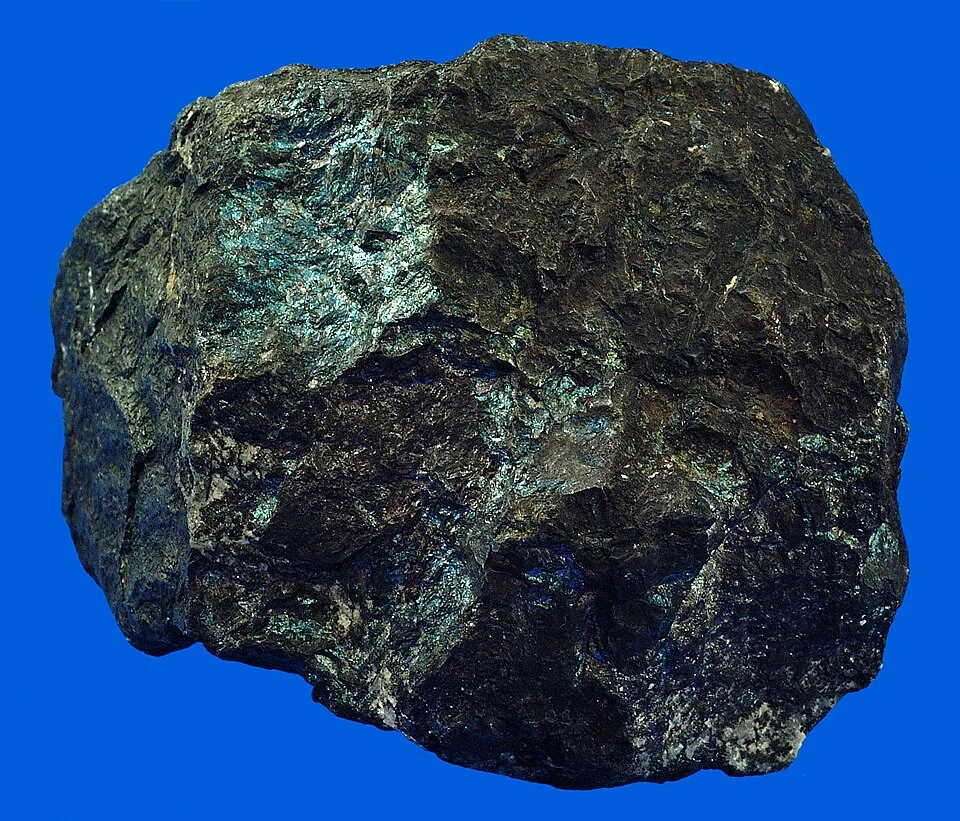
This specimen of bornite is 9 cm across. Bornite, Cu5FeS4 (copper iron sulfide), is an important copper ore mineral. It rarely forms good crystals; massive samples such as the one shown are typical. Although coppery red to brown on fresh surfaces, bornite readily tarnishes to iridescent purple. It is sometimes called peacock ore because of its color.

Breccia specimen

Breccia

Photographer / creator: James St. John

License: CC BY 2.0

Original: File:Carbonate megabreccia (Titus Canyon, Grapevine Mountains, California, USA) 2.jpg

Resized to at most 960 pixels and converted to WebP; no cropping.

Source credit and review

https://www.flickr.com/photos/47445767@N05/51412525934/

Visual appearance and source description reviewed for the named mineral, variety or rock. Selected for visible diagnostic features; no specimen-name label is visible.

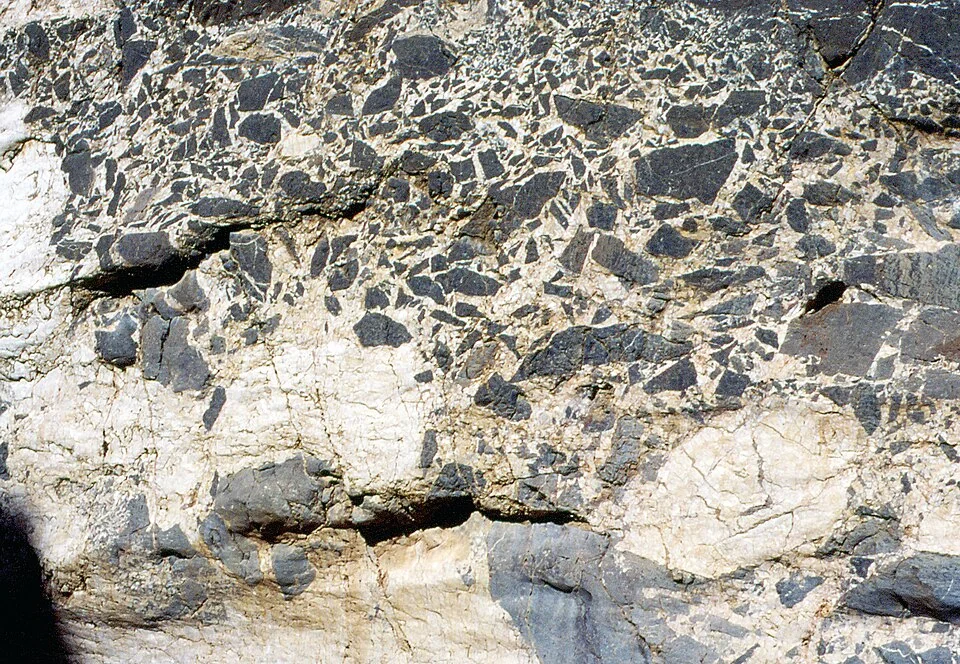
Carbonate megabreccia in California, USA. This outcrop is along the walls of Titus Canyon in the Grapevine Mountains of Death Valley National Park, California. The mountain range is a horst - an uplifted block formed by extensional tectonics. To the west of here is Death Valley, which is a graben - a down-dropped block formed by the same process. In terrains with horsts and grabens, major normal faults define the boundaries between mountain ranges and valleys. Death Valley is an especially low graben. Its valley floor reaches well below sea level (about 280 feet). The rocks seen here consist of a carbonate megabreccia. Breccias are poorly sorted rocks with angular clasts - a mix of large and small pieces, with angular-shaped large pieces. Many specific varieties of breccia exist (e.g., volcanic breccia, sedimentary breccia, karst collapse breccia, impact breccia, fault breccia, etc.). This one is a fault breccia. The gray colored clasts are limestone fragments of the Cambrian-aged Bonanza King Formation. The light-colored material between the clasts is calcite cement. Locality: Titus Canyon Narrows, Grapevine Mountains, Death Valley National Park, eastern Inyo County, California, USA

Calcite specimen

Calcite

Photographer / creator: PaleoNeolitic (montage creator)

License: CC BY 4.0

Original: File:Calcite Variation.png

Resized to at most 960 pixels and converted to WebP; no cropping.

Source credit and review

Wikimedia Commons

Source description and visible appearance reviewed for specimen identity, diagnostic texture or crystal habit. Selected photo has no visible specimen-name label.

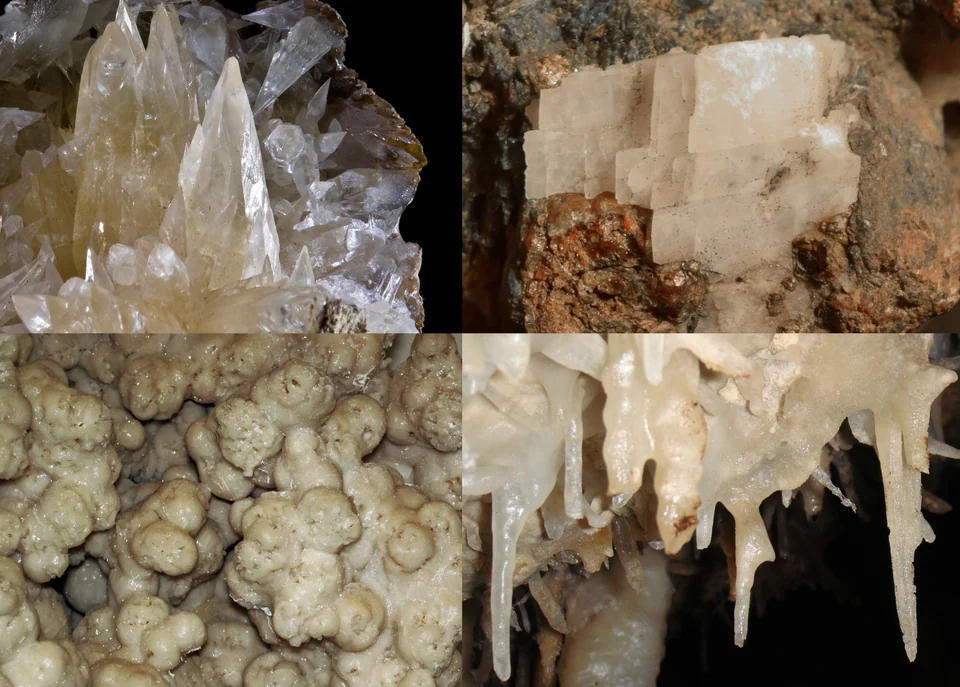
Montage featuring the high variation of crystal habits of the carbonate mineral calcite (CaCO3). Clockwise from top left: scalenohedral, rhomboedral, stalactitic, and botryoidal calcite crystals. These files are already on Commons with their respective licenses. This montage was made for the article Calcite on Wikipedia. File:Calcite-Maroc-UV.jpg File:NM Epidote Calcite2.jpg File:Vallina Estalactitas banderolas helictitas.JPG File:Calcite (Cave-in-Rock Mining District, Illinois, USA) 3 (42590140555).jpg

Celestite specimen

Celestite

Photographer / creator: Ivar Leidus

License: CC BY-SA 4.0

Original: File:Celestine - Sakoany deposit, Katsepy, Mitsinjo, Boeny, Madagascar.jpg

Resized to at most 960 pixels and converted to WebP; no cropping.

Source credit and review

Own work

Source description and visible appearance reviewed for specimen identity, diagnostic texture or crystal habit. Selected photo has no visible specimen-name label.

Celestine crystals (field of view 3.5 × 2.6 cm). Found from Sakoany deposit, Katsepy, Mitsinjo District, Boeny region, Madagascar

Chalcopyrite specimen

Chalcopyrite

Photographer / creator: Rob Lavinsky, iRocks.com – CC-BY-SA-3.0 · iRocks.com

License: CC BY-SA 3.0

Original: File:Chalcopyrite-199453.jpg

Resized to at most 960 pixels and converted to WebP; no cropping.

Source credit and review

http://www.mindat.org/photo-199453.html

Source description and visible appearance reviewed for specimen identity, diagnostic texture or crystal habit. Selected photo has no visible specimen-name label.

Chalcopyrite Locality: Ballard Mine, Baxter Springs , Picher Field, Tri-State District, Cherokee County, Kansas , USA ( Locality at mindat.org ) Size: 6.9 x 4.8 x 2.8 cm. An old Treece chalcopyrite specimen out of the Feist Collection, with very sharp, bright brassy crystals to one centimeter. In one place is a beautiful complex cluster of interpenetrating crystals. The crystals are nicely isolated on the matrix. Probably collected prior to the 1960s.

Chalk specimen

Chalk

Photographer / creator: James St. John

License: CC BY 2.0

Original: File:Platyceramus platinus inoceramid bivalve in chalk (Smoky Hill Chalk Member, Niobrara Formation, Upper Cretaceous; Castle Rock chalk badlands, south of Quinter, Kansas, USA) 1 (19306128354).jpg

Resized to at most 960 pixels and converted to WebP; no cropping.

Source credit and review

Platyceramus platinus inoceramid bivalve in chalk (Smoky Hill Chalk Member, Niobrara Formation, Upper Cretaceous; Castle Rock chalk badlands, south of Quinter, Kansas, USA) 1

Visual appearance and source description reviewed for the named mineral, variety or rock. Selected for visible diagnostic features; no specimen-name label is visible.

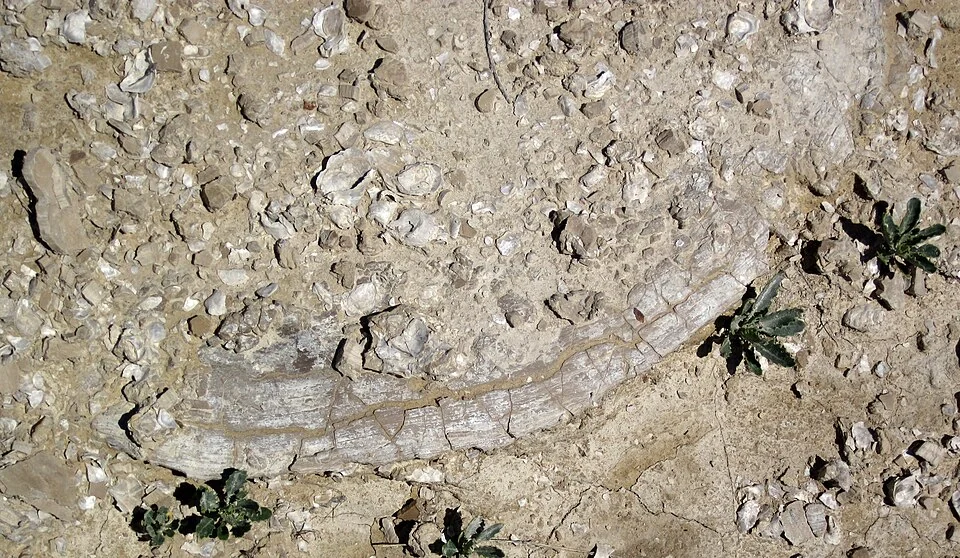
Platyceramus platinus (Logan, 1898) - fossil bivalve in chalk in the Cretaceous of Kansas, USA. Inoceramid bivalves included the largest clams in Earth history - they are known to have reached about 10 feet in size (for a complete specimen, see: <a href=" https://en.wikipedia.org/wiki/Platyceramus#/media/File:Platyceramus_platinus_with_Pseudoperna_congesta,_Gove_County,_Kansas,_USA,_Late_Cretaceous_-_Royal_Ontario_Museum_-_DSC00063.JPG " rel="nofollow">en.wikipedia.org/wiki/Platyceramus#/media/File:Platyceram...</a>). Inoceramids are often described as having a turkey platter morphology - they had large, relatively thin shells that spread out their weight on soft, fine-grained, nonlithified chalk seafloors. The above photo depicts the margin of a large Platyceramus bivalve shell eroding from an outcrop of chalk near Castle Rock, south of Quinter, Kansas. These fossils are relatively common at this locality and at other chalk exposures in western Kansas. Classification: Animalia, Mollusca, Bivalvia, Pteriomorphia, Praecardioida, Inoceramidae Stratigraphy: Smoky Hill Chalk Member (a.k.a. Smoky Hills Member), Niobrara Formation, Upper Cretaceous Locality: Castle Rock chalk badlands, north of Gove County Road K & east of Castle Rock Road, 23 kilometers south-southeast of the town of Quinter, eastern Gove County, western Kansas, USA

Chert/Flint specimen

Chert/Flint

Photographer / creator: Mike Davis

License: CC0

Original: File:Chert (GeoDIL number - 291).jpg

Resized to at most 960 pixels and converted to WebP; no cropping.

Source credit and review

https://geodil.dperkins.org/h/291.html

Source description and full photograph reviewed for the correct material and visible diagnostic texture. No specimen-name label is visible.

Chert is a name used for a mineral-like mix of fibrous chalcedony with lesser amounts of quartz and opal. It is also the name used to describe a rock made of those materials. This specimen is dense with a light gray color, but chert comes in many different colors. When it has a dark color, it is commonly called flint. Most samples (including this sample) of chert exhibit conchoidal or splintery fracture. This sample is about 9 cm across.

Chrysocolla specimen

Chrysocolla

Photographer / creator: Darla Sondrol

License: CC0

Original: File:Chrysocolla, malachite, quartz (GeoDIL number - 751).jpg

Resized to at most 960 pixels and converted to WebP; no cropping.

Source credit and review

https://geodil.dperkins.org/h/751.html

Source description and full photograph reviewed for the correct material and visible diagnostic texture. No specimen-name label is visible.

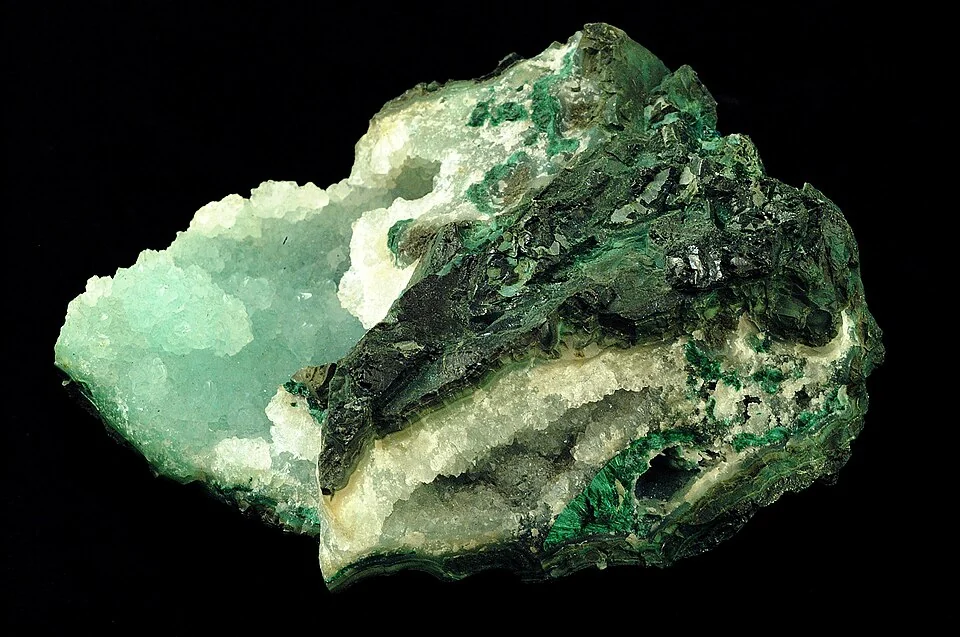
The light green-turquoise sugary material is chrysocolla, CuSiO3•nH2O, (hydrated copper silicate). It generally has an attractive blue-green color that is distinctive in the mineral world. Chyrsocolla is really a mineraloid, not a true mineral. Most of the time it is amorphous (meaning that it does not have a coherent crystalline structure). At high temperatures it does demonstrate a distorted crystal structure that seems to be composed of Si4O10 sheets. Chrysocolla forms in the oxidation zones of copper rich ore bodies. In this sample, chrysocolla is accomapanied by dark green malachite, and white quartz. Also present is minor black cuprite. This sample is 10 cm across.

Citrine specimen

Citrine

Photographer / creator: Paweł Maliszczak [hardleo.com]

License: CC BY-SA 4.0

Original: File:Rough Citrine Cristals Quartz from Brasil.jpg

Resized to at most 960 pixels and converted to WebP; no cropping.

Source credit and review

Own work

Visual appearance and source description reviewed for the named mineral, variety or rock. Selected for visible diagnostic features; no specimen-name label is visible.

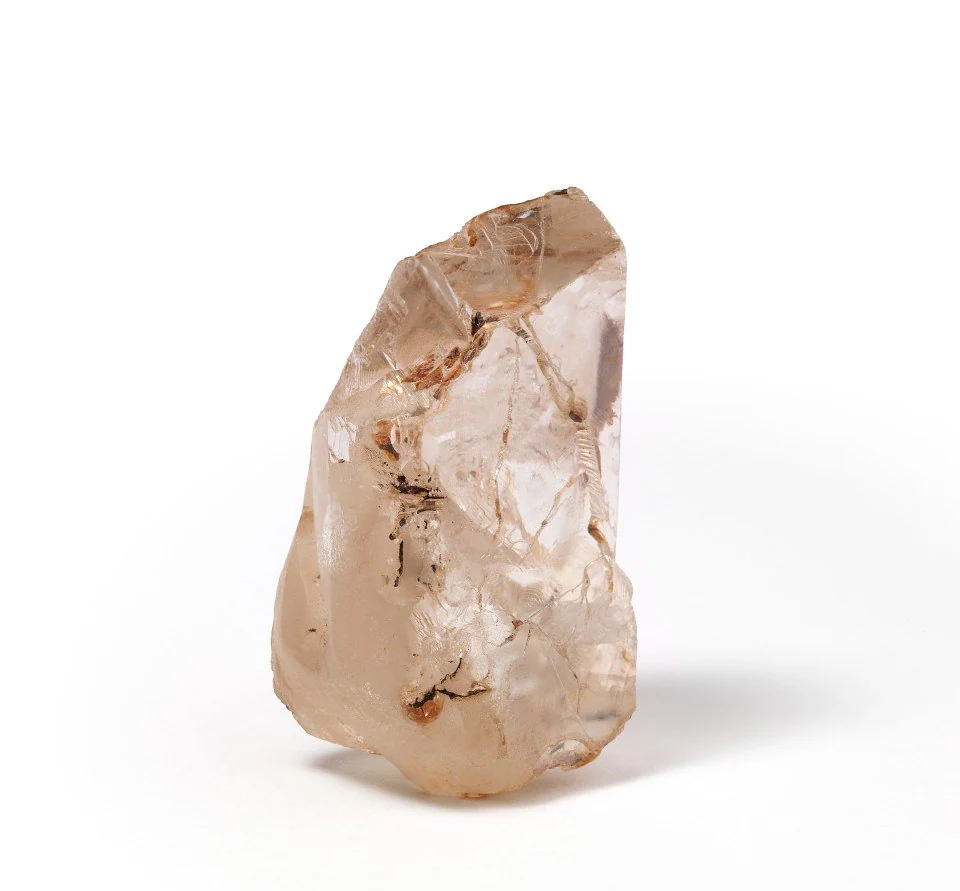
Rough Citrine Crystals Quartz from Brasil

Conglomerate specimen

Conglomerate

Photographer / creator: James St. John

License: CC BY 2.0

Original: File:Quartz-pebble conglomerate ("Sharon Conglomerate", Lower Pennsylvanian; Jackson North roadcut, Ohio, USA) 39 (26244649987).jpg

Resized to at most 960 pixels and converted to WebP; no cropping.

Source credit and review

Quartz-pebble conglomerate ("Sharon Conglomerate", Lower Pennsylvanian; Jackson North roadcut, Ohio, USA) 39

Source description checked against the specimen; visual review confirms a usable crystal, aggregate or rock exposure without a specimen-name label.

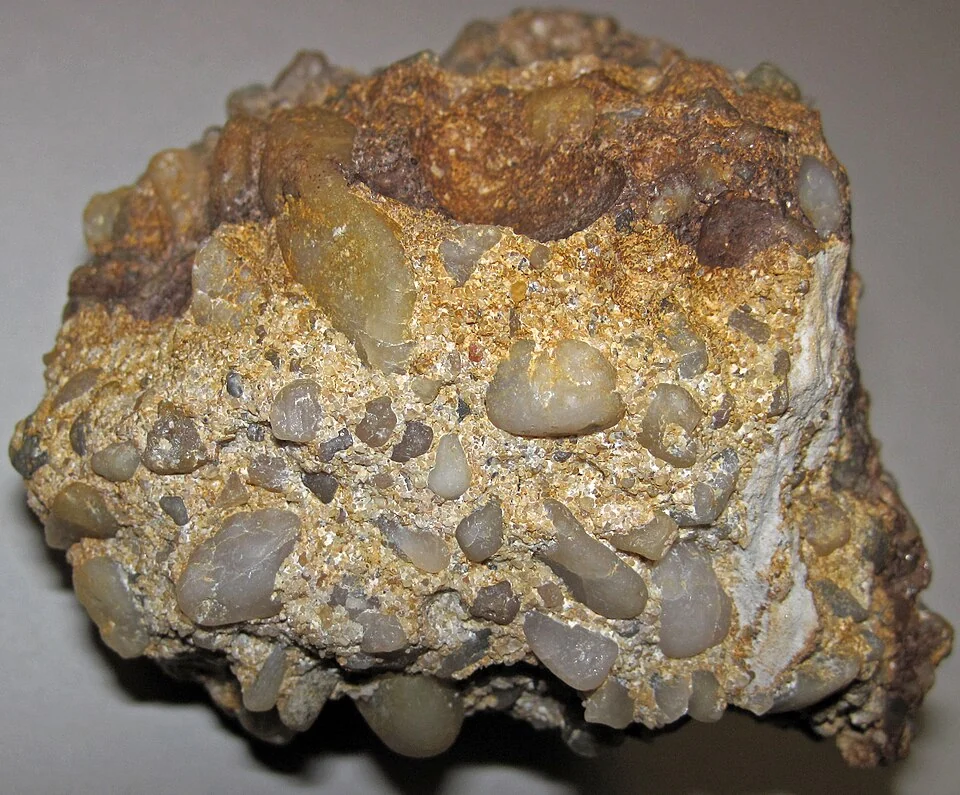
Conglomerate from the Pennsylvanian of Ohio, USA. This rock is from the lowermost Pottsville Group, a Pennsylvanian-aged, cyclothemic succession in eastern Ohio that contains nonmarine shales, marine shales, siltstones, sandstones, coals, marine limestones, and chert ("flint"). The lower Pottsville dates to the late Early Pennsylvanian. The upper part dates to the early Middle Pennsylvanian. The Lower-Middle Pennsylvanian boundary is apparently somewhere near the Boggs Member (?). At this southern Ohio site, the basal Pottsville is a spectacular quartz-pebble conglomerate, with a quartzose sandstone unit above it, plus coal and sandstone shale above that. In eastern and northeastern Ohio, the conglomeratic base of the Pottsville Group is called the Sharon Conglomerate (a.k.a. Sharon Sandstone; Sharon Formation; Sharon Member). The literature points out that the Sharon elsewhere in Ohio is not directly correlatable with the conglomerate exposed at this site near Jackson, Ohio. Thus, it has been suggested that the unit at this locality be referred to as the "Sharon" Conglomerate. Here, the rocks are generally massive (= non-bedded) quartz-pebble conglomerates. Other clast lithologies and sizes are also present, including angular shale clasts, angular sandstone clasts (both derived from erosion of the underlying Logan Formation of Early Mississippian age), rounded to irregularly-shaped ironstone clasts, rounded quartz sandstone pebbles, rounded quartzite pebbles, and rounded silicified limestone pebbles. A very unusual clast type present at this outcrop is ferruginous, pyrite-cemented and hematite-cemented, quartz-pebble conglomerate (= conglomerate in conglomerate ! ). The rusty coloration in this rock sample is from iron oxide. Stratigraphy: "Sharon" Conglomerate, lowermost Pottsville Group, Lower Pennsylvanian Locality: Jackson North Outcrop - roadcut along the southwestern side of Rt. 35, immediately southeast of the Rt. 35-Lloyds Bridge Road intersection (the northwestern intersection - there are two of them), north of the town of Jackson, northwest-central Jackson County, southern Ohio, USA (39° 06’ 32.94” North latitude, 82° 40’ 39.99” West longitude)

Copper specimen

Copper

Photographer / creator: Native_Copper_Macro_Digon3.jpg : “Jonathan Zander ( Digon3 )" derivative work: Materialscientist ( talk )

License: CC BY-SA 3.0

Original: File:NatCopper.jpg

Resized to at most 960 pixels and converted to WebP; no cropping.

Source credit and review

Native_Copper_Macro_Digon3.jpg

Source description and visible appearance reviewed for specimen identity, diagnostic texture or crystal habit. Selected photo has no visible specimen-name label.

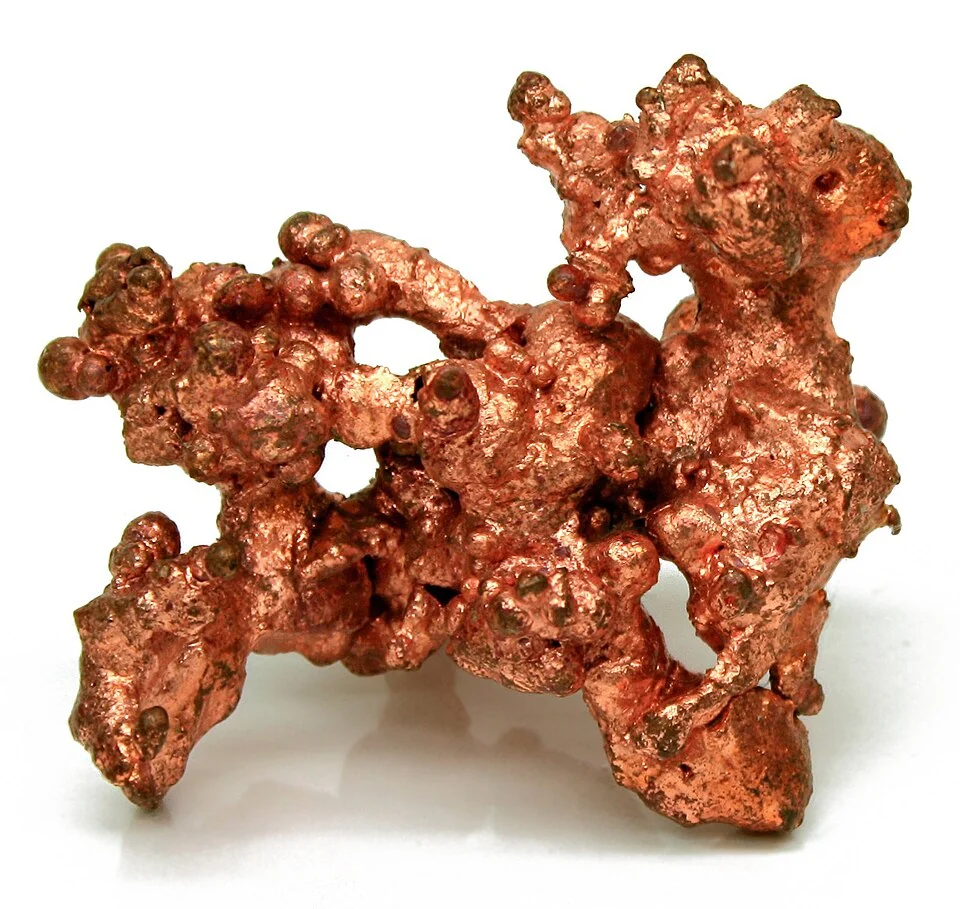
Macro of native copper about 1 ½ inches (4 cm) in size.

Coquina specimen

Coquina

Photographer / creator: James St. John

License: CC BY 2.0

Original: File:Coquina (Anastasia Formation, Pleistocene or Holocene; Cayo Costa Island, Florida, USA) (26032505336).jpg

Resized to at most 960 pixels and converted to WebP; no cropping.

Source credit and review

Coquina (Anastasia Formation, Pleistocene or Holocene; Cayo Costa Island, Florida, USA)

Visual appearance and source description reviewed for the named mineral, variety or rock. Selected for visible diagnostic features; no specimen-name label is visible.

Coquina from the Quaternary of Florida, USA. Sedimentary rocks form by the solidification of loose sediments. Loose sediments become hard rocks by the processes of deposition, burial, compaction, dewatering, and cementation. There are three categories of sedimentary rocks: 1) Siliciclastic sedimentary rocks form by the solidification of sediments produced by weathering & erosion of any previously existing rocks. 2) Biogenic sedimentary rocks form by the solidification of sediments that were once-living organisms (plants, animals, micro-organisms). 3) Chemical sedimentary rocks form by the solidification of sediments formed by inorganic chemical reactions. Most sedimentary rocks have a clastic texture, but some are crystalline. Limestone is a common biogenic sedimentary rock composed of the mineral calcite (CaCO3), which bubbles in acid. Many geologically young limestones are composed of aragonite (also CaCO3). Numerous varieties of limestone exist (e.g., fine-grained limestone/micritic limestone/lime mudstone, coquina, chalk, wackestone, packstone, grainstone, rudstone, rubblestone, coralstone, calcarenite, calcisiltite, calcilutite, calcirudite, floatstone, boundstone, framestone, oolitic limestone, oncolitic limestone, etc.). The most distinctive type can be given the generalized name fossiliferous limestone, which is composed of abundant whole & fragmented fossil shells and skeletons, usually mixed with mud. Most limestones represent deposition in ancient warm, shallow ocean environments. The sample shown above is a distinctive variety of fossiliferous limestone called coquina. It is composed of mollusc shells and fragmented shells (typically clam and snail shells - bivalves and gastropods). Coquinas have high porosity - a significant amount of empty space exists between the grains. This results in coquina having a spongy appearance. Coquina had military significance in early American history. Some military forts in Florida were constructed with coquina walls. The coquina essentially absorbed any cannonballs that were shot at the fort. Coquina is a fairly common sedimentary rock in the Quaternary of Florida. Stratigraphy: Anastasia Formation, Pleistocene or Holocene Locality: loose piece on marine beach near the southern end of the western shoreline of Cayo Costa Island, Gulf of Mexico coast of southwestern Florida, USA (vicinity of 26° 36' 51.30" North latitude, 82° 13' 24.39" West longitude)

Corundum specimen

Corundum

Photographer / creator: Ra'ike (see also Ra'ike on de.wikipedia

License: CC BY-SA 3.0

Original: File:Several corundum crystals.jpg

Resized to at most 960 pixels and converted to WebP; no cropping.

Source credit and review

Image:Sapphire01.jpg from Azuncha reduced and optical cleared

Source description and visible appearance reviewed for specimen identity, diagnostic texture or crystal habit. Selected photo has no visible specimen-name label.

several corundum crystals

Diamond specimen

Diamond

Photographer / creator: DGPC/ADF Luísa Oliveira

License: CC0

Original: File:Rough Diamond.jpg

Resized to at most 960 pixels and converted to WebP; no cropping.

Source credit and review

https://www.tesouroreal.pt/en/pages/b9ed8b00-ouro-e-diamantes-do-brasil

Source description and visible appearance reviewed for specimen identity, diagnostic texture or crystal habit. Selected photo has no visible specimen-name label.

This specimen is a fragment of a much larger diamond that is thought to have been composed of yet another fragment that is mentioned historically throughout the 18th and 19th centuries as a 135 carat gem and which was weighed in 1911 for the old royal palaces' Inventory as a 27.7 g (138.5 carats) stone. The brownish hue is due to superficial ferrous impurities that constitute evidence of the geological sedimentary context in which it was found. This diamond is potentially colourless.

Diatomite specimen

Diatomite

Photographer / creator: James St. John

License: CC BY 2.0

Original: File:Diatomite (Sisquoc Formation, Miocene-Pliocene; Palos Colorados Quarry, California, USA) 5.jpg

Resized to at most 960 pixels and converted to WebP; no cropping.

Source credit and review

https://www.flickr.com/photos/47445767@N05/51160145217/

Source description checked against the specimen; visual review confirms a usable crystal, aggregate or rock exposure without a specimen-name label.

Marine diatomite from the Tertiary of California, USA. (bedding plane view) Diatomite, or diatomaceous earth, is an uncommon but distinctive biogenic sedimentary rock - it is whitish, powdery, and very lightweight. It seems quite soft, but the individual particles making up the rock are siliceous (opaline silica) and have a hardness around 6 on the Mohs Scale. This makes diatomaceous earth a mild abrasive. It is mined for use in a wide variety of products - most people encounter diatomites everyday as one of the ingredients in toothpaste (the opaline silica scrapes away foreign material from tooth surfaces). Diatomites form by the accumulation of numerous diatom skeletons in lake or marine settings. Diatoms are very small, unicellular, photosynthetic organisms (Kingdom Protista, Phylum Bacillariophyta). Some call them “algae”, but they’re not. Some call them “plants”, but they’re not. They’re protists. Diatoms make a two-part skeleton composed of opal (opaline silica, SiO2·nH2O). Diatom skeletons are called frustules (Examples: www.flickr.com/photos/neman78/14675239453). Diatom frustules are usually rounded or elongated, and the two parts of the skeleton nest into each other, like a large petri dish over a slightly smaller petri dish. Careful examination of fossil diatoms typically requires use of a scanning electron microscope (SEM). Diatomites contain immense numbers of many different species of fossil diatoms. The appearance of diatomite closely resembles chalk. Chalk is calcareous, and will bubble in acid - diatomite won’t do that. Chalk is also noticeably heavier than diaomite. Diatomite and chalk also resemble kaolinite, a clay mineral. Kaolinite will not bubble in acid. It also has an earthy feel and an earthy smell, especially when wet. Kaolinite becomes noticeably sticky when wet. Stratigraphy: Sisquoc Formation, Upper Miocene to Lower Pliocene Locality: Grefco Incorporated's Palos Colorados Quarry, southeast of the town of Lompoc, Santa Barbara County, southern California, USA (vicinity of 34° 34' 31.27 North latitude, 120° 20' 40.13 West longitude)

Dioptase specimen

Dioptase

Photographer / creator: Géry PARENT

License: CC BY-SA 4.0

Original: File:Dioptase, quartz 1100.2612.jpg

Resized to at most 960 pixels and converted to WebP; no cropping.

Source credit and review

Own work

Source description checked against the specimen; visual review confirms a usable crystal, aggregate or rock exposure without a specimen-name label.

dioptase, quartz : Kaokoveld Plateau, Kunene Region, Namibia

Diorite specimen

Diorite

Photographer / creator: Tõnis Saadre

License: CC BY-SA 4.0

Original: File:Estonian Museum of Natural History Specimen No 176270 photo (g203 g203-2 jpg).jpg

Resized to at most 960 pixels and converted to WebP; no cropping.

Source credit and review

Estonian Museum of Natural History

Source description checked against the rock type; selected for visible hand-specimen texture. Museum inventory numbers are not identification labels.

Igneous rock: diorite. More info about this file and about this specimen at geocollections.info

Dolomite specimen

Dolomite

Photographer / creator: Didier Descouens

License: CC BY-SA 4.0

Original: File:Dolomite Luzenac.jpg

Resized to at most 960 pixels and converted to WebP; no cropping.

Source credit and review

Own work

Source description and visible appearance reviewed for specimen identity, diagnostic texture or crystal habit. Selected photo has no visible specimen-name label.

Dolomite and Talc Locality : Trimouns Talc Mine, Luzenac, Ariège, Midi-Pyrénées, France Size 10x6.2cm

Dolostone specimen

Dolostone

Photographer / creator: James St. John

License: CC BY 2.0

Original: File:Dolostone (Rockford Limestone, Lower Mississippian; Burkesville West Rt. 90 roadcut, Kentucky, USA) 12 (31681359467).jpg

Resized to at most 960 pixels and converted to WebP; no cropping.

Source credit and review

Dolostone (Rockford Limestone, Lower Mississippian; Burkesville West Rt. 90 roadcut, Kentucky, USA) 12

Visual appearance and source description reviewed for the named mineral, variety or rock. Selected for visible diagnostic features; no specimen-name label is visible.

Dolostone in the Mississippian of Kentucky, USA. This is the Rockford Limestone, a relatively thin interval of dolostone. Very weathered surfaces are yellowish-brown to brown in color. Fresh, crack surfaces are light to medium gray in color. Biostratigraphic studies indicate that the Kinderhookian-Osagean boundary is within the Rockford. At this site, the Rockford has silicified fossils (e.g., crinoid stems). The overlying gray shale is part of the Fort Payne Formation. Stratigraphy: Rockford Limestone, uppermost Kinderhookian to lowermost Osagean, mid-Lower Mississippian Locality: roadcut on the northern side of Route 90, just west of Burkesville, central Cumberland County, southern Kentucky, USA (36° 48’ 01.98” North latitude, 85° 22’ 48.93” West longitude)

Epidote specimen

Epidote

Photographer / creator: Gleb Korovko

License: CC BY 4.0

Original: File:Эпидот(пушкинит).jpg

Resized to at most 960 pixels and converted to WebP; no cropping.

Source credit and review

Own work

Source description and visible appearance reviewed for specimen identity, diagnostic texture or crystal habit. Selected photo has no visible specimen-name label.

Epidote crystals on matrix mined in Katsna Yama, Pervouralsk, Sverdlovsk Oblast, Russia – Field of view: 6 mm

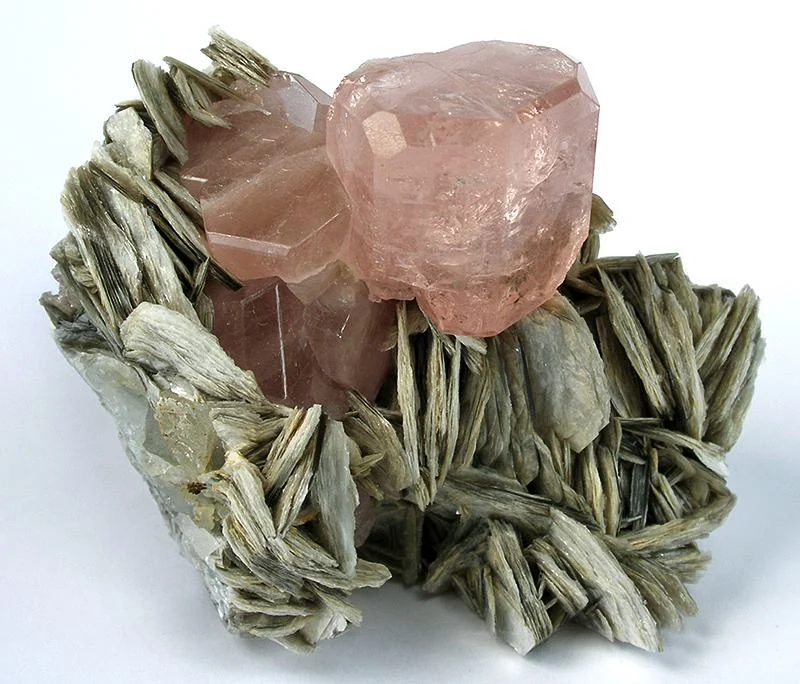
Fluorapatite specimen

Fluorapatite

Photographer / creator: Rob Lavinsky, iRocks.com – CC-BY-SA-3.0 · iRocks.com

License: CC BY-SA 3.0

Original: File:Fluorapatite-Muscovite-tuc8-098a.jpg

Resized to at most 960 pixels and converted to WebP; no cropping.

Source credit and review

Image: http://www.irocks.com/db_pics/pics/tuc8-098a.jpg , Description: http://www.irocks.com/render.html?species=Muscovite&page=20

Source description and visible appearance reviewed for specimen identity, diagnostic texture or crystal habit. Selected photo has no visible specimen-name label.

Apatite-(CaF) , Muscovite Locality: Chumar Bakhoor, Hunza Valley , Gilgit District , Northern Areas , Pakistan ( Locality at mindat.org ) Size: small cabinet, 7.6 x 6.2 x 4.6 cm Fluorapatite on Muscovite From the gem pegmatites of Pakistan, this aesthetic specimen features a castle-like cluster of glassy and gemmy, pink crystals of fluorapatite to 2.0 cm in length, perched on contrasting crystals of muscovite to 1.3 cm across. The largest fluorapatite crystal is doubly terminated and almost an inch in size. It is nearly perfect but does have a small ding to the back of the top termination... when properly displayed this is not evident. Overall, considering these are usually priced at the source as if they were pink gold crystals, this is a very aesthetic specimen at a fair price, with remarkably freestanding presentation of the crystals. I obtained it direct at the mines and trimmed it up to get it this way...with some luck, I admit!

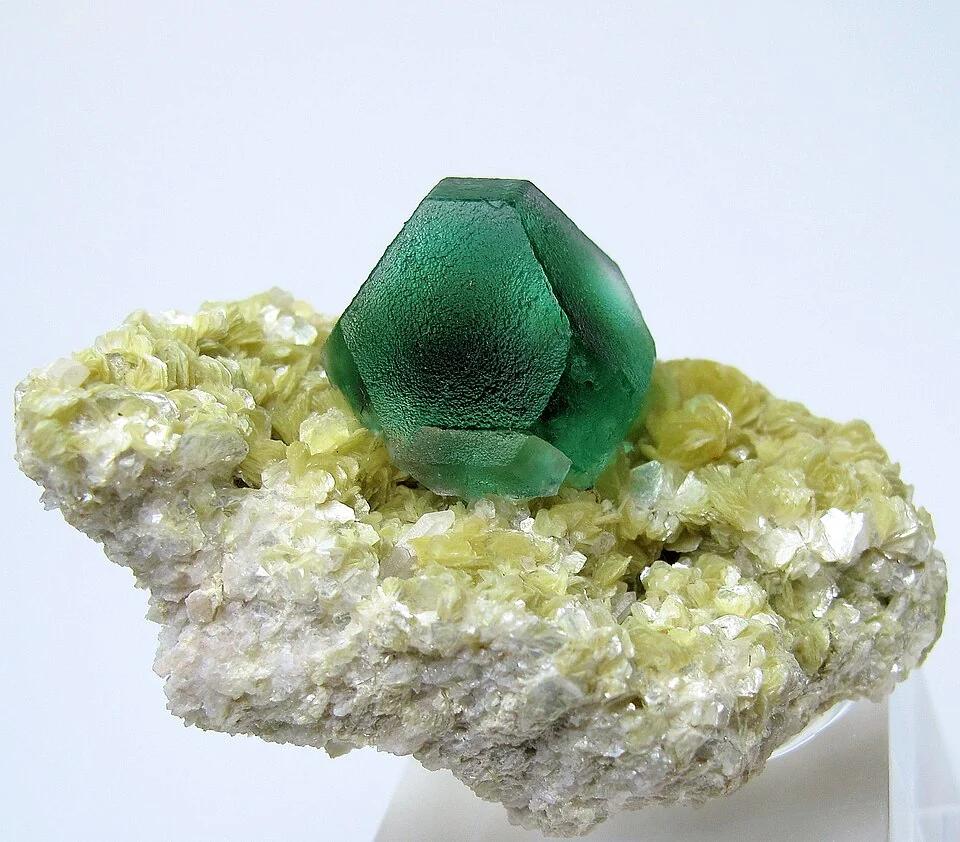
Fluorite specimen

Fluorite

Photographer / creator: CarlesMillan

License: CC BY-SA 3.0

Original: File:3192M-fluorite1.jpg

Resized to at most 960 pixels and converted to WebP; no cropping.

Source credit and review

Own work

Source description and visible appearance reviewed for specimen identity, diagnostic texture or crystal habit. Selected photo has no visible specimen-name label.

Deep green isolated fluorite crystal showing cubic {100} and octahedral {111} faces, complete and undamaged, set upon a micaceous matrix. Overall size: 50 mm x 27 mm. Crystal size: 19 mm wide. Weight: 30 g. From Erongo Mountain, Erongo Region, Namibia.

Fossil Limestone specimen

Fossil Limestone

Photographer / creator: Manishwiki15

License: CC BY-SA 3.0

Original: File:Fossiliferous Limestone.JPG

Resized to at most 960 pixels and converted to WebP; no cropping.

Source credit and review

Own work

Source description checked against the specimen; visual review confirms a usable crystal, aggregate or rock exposure without a specimen-name label.

Sample of Fossiliferous Limestone

Gabbro specimen

Gabbro

Photographer / creator: James St. John

License: CC BY 2.0

Original: File:Olivine gabbro (Pigeon Point Sill, Mesoproterozoic, ~1.1 Ga; Pigeon Point, Minnesota, USA) (40770721514).jpg

Resized to at most 960 pixels and converted to WebP; no cropping.

Source credit and review

Olivine gabbro (Pigeon Point Sill, Mesoproterozoic, ~1.1 Ga; Pigeon Point, Minnesota, USA)

Source description checked against the rock type; selected for visible hand-specimen texture. Museum inventory numbers are not identification labels.

Olivine gabbro from the Precambrian of Minnesota, USA (public display, Geology Department, Wittenberg University, Springfield, Ohio, USA) Along the northern shore of western Lake Superior are numerous exposures of a lava flow-dominated succession called the North Shore Volcanic Group. This is equivalent to & the same age as the Portage Lake Volcanic Series of northern Michigan's Keweenaw Peninsula (<a href=" https://www.flickr.com/photos/jsjgeology/albums/72157632266738191 ">www.flickr.com/photos/jsjgeology/albums/72157632266738191</a>). The North Shore and Portage Lake successions are ~1.1 billion years old and represent basalt lava flows, plus minor sedimentary rocks, that filled up an ancient rift valley. This old rift is the Lake Superior segment of the Mid-Continent Rift System, a tear in the ancient North American paleocontinent of Laurentia (see: <a href=" https://minerals.usgs.gov/science/midcontinent-rift-minerals/images/MRS-map.png " rel="noreferrer nofollow">minerals.usgs.gov/science/midcontinent-rift-minerals/imag...</a>). Tectonic rifting started along this tear, exactly like the modern-day East African Rift Valley. Laurentia's Mid-Continent Rift System started and then stopped and was subsequently filled and buried. This ancient failed rift is now exposed on either side of Lake Superior in North America's Great Lakes. The sample shown here is from an intrusion emplaced at the same time as North Shore volcanics were being erupted. The rock is a phaneritic, mafic, intrusive igneous rock called gabbro. Gabbro has plagioclase feldspar and pyroxene. This particular specimen also has a fair amount of olivine, so it is an "olivine gabbro". Some might characterize it as a troctolite. Accompanying exhibit signage identifies it as an olivine diabase, but the crystals are too large for that - it appears to be a gabbro. The igneous body itself is a sill - a planar intrusion that parallels the country rocks. In contrast, an igneous dike is a planar intrusion that cuts across the country rocks (see: <a href=" https://www.flickr.com/photos/jsjgeology/albums/72157632467411234 ">www.flickr.com/photos/jsjgeology/albums/72157632467411234</a>). Geologic unit & age: Pigeon Point Sill, late Mesoproterozoic, ~1.1 Ga Locality: unrecorded/undisclosed site at Pigeon Point, northern shore of Lake Superior, west of Isle Royale, adjacent to the Canadian-American border, far-northeastern Minnesota, USA

Galena specimen

Galena

Photographer / creator: Ivar Leidus

License: CC BY-SA 4.0

Original: File:Galena - Huallanca, Bologesi, Ancash, Peru.jpg

Resized to at most 960 pixels and converted to WebP; no cropping.

Source credit and review

Own work

Source description and visible appearance reviewed for specimen identity, diagnostic texture or crystal habit. Selected photo has no visible specimen-name label.

Galena with some golden colored pyrite (3.5 × 2.5 × 2.0 cm) from Huanzala mine, Huallanca, Bolognesi, Ancash, Peru

Garnet Schist specimen

Garnet Schist

Photographer / creator: James St. John

License: CC BY 2.0

Original: File:Garnet-mica schist (Gassetts, Vermont, USA) 2.jpg

Resized to at most 960 pixels and converted to WebP; no cropping.

Source credit and review

https://www.flickr.com/photos/47445767@N05/53310387059/

Source description and full photograph reviewed for the correct material and visible diagnostic texture. No specimen-name label is visible.

Schist is an intermediate- to high-grade, foliated metamorphic rock. It is highly variable in appearance, depending on the mineral content, which is a consequence of specific temperature-pressure conditions and the type of precursor rock. Garden-variety schists form by metamorphism of phyllites. Schists typically have medium- to large-sized crystals, unlike the microcrystalline nature of slate & phyllite. Schist's foliated texture (= crystals aligned into bands or stripes or layers) is often only seen when specimens are viewed on edge. Locality: unrecorded / undisclosed site at or near the town of Gassetts, southeastern Vermont, USA

Gneiss specimen

Gneiss

Photographer / creator: James St. John

License: CC BY 2.0

Original: File:Gneiss 1 (16310656713).jpg

Resized to at most 960 pixels and converted to WebP; no cropping.

Source credit and review

Gneiss 1

Compared source description and visible specimen features; selected a representative crystal, aggregate or rock texture rather than an associated mineral or landscape.

Gneiss (6.8 cm across at its widest) Metamorphic rocks result from intense alteration of any previously existing rocks by heat and/or pressure and/or chemical change. This can happen as a result of regional metamorphism (large-scale tectonic events, such as continental collision or subduction), burial metamorphism (super-deep burial), contact metamorphism (by the heat & chemicals from nearby magma or lava), hydrothermal metamorphism (by superheated groundwater), shear metamorphism (in or near a fault zone), or shock metamorphism (by an impact event). Other categories include thermal metamorphism, kinetic metamorphism, and nuclear metamorphism. Many metamorphic rocks have a foliated texture, but some are crystalline or glassy. Gneiss is a high-grade, foliated metamorphic rock. It differs from lower grade foliated metamorphics, such as slate, phyllite, and schist, by having alternating bands or stripes of light and dark minerals. Metamorphism has been so intense that minerals have self-segregated into discrete zones. Most gneisses form by metamorphism of schists or granites. The specimen shown above is a quartz-biotite gneiss. The whitish-gray bands are quartz (SiO2) and the black bands are biotite mica.

Goethite/Limonite specimen

Goethite/Limonite

Photographer / creator: Rob Lavinsky, iRocks.com – CC-BY-SA-3.0 · iRocks.com

License: CC BY-SA 3.0

Original: File:Goethite-169735.jpg

Resized to at most 960 pixels and converted to WebP; no cropping.

Source credit and review

http://www.mindat.org/photo-169735.html

Source description and visible appearance reviewed for specimen identity, diagnostic texture or crystal habit. Selected photo has no visible specimen-name label.

Goethite Locality: Crystal Peak area, Teller County , Colorado , USA ( Locality at mindat.org ) Size: 5.9 x 5.2 x 5.2 cm. Goethite is pretty ugly in most of its forms, and is rarely seen in actual crystals. One exception is these Colorado specimens, where you see these sprays of lustrous crystals - here, to almost 4 cm in length. Ex. Dave Stoudt Collection.

Gold specimen

Gold

Photographer / creator: Alchemist-hp ( talk ) www.pse-mendelejew.de

License: CC BY-SA 3.0 de

Original: File:Gold-crystals.jpg

Resized to at most 960 pixels and converted to WebP; no cropping.

Source credit and review

Own work

Source description and visible appearance reviewed for specimen identity, diagnostic texture or crystal habit. Selected photo has no visible specimen-name label.

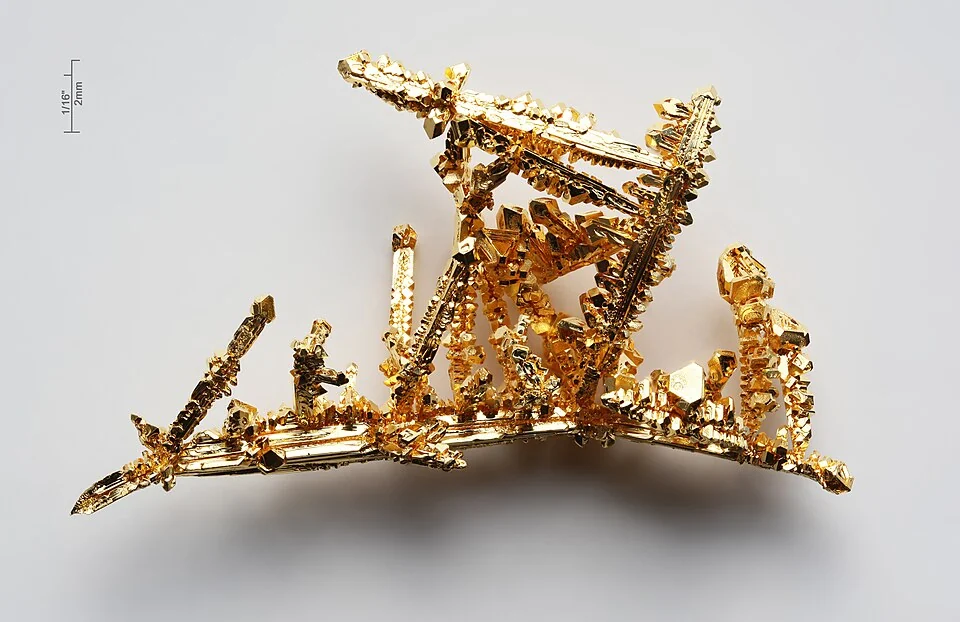
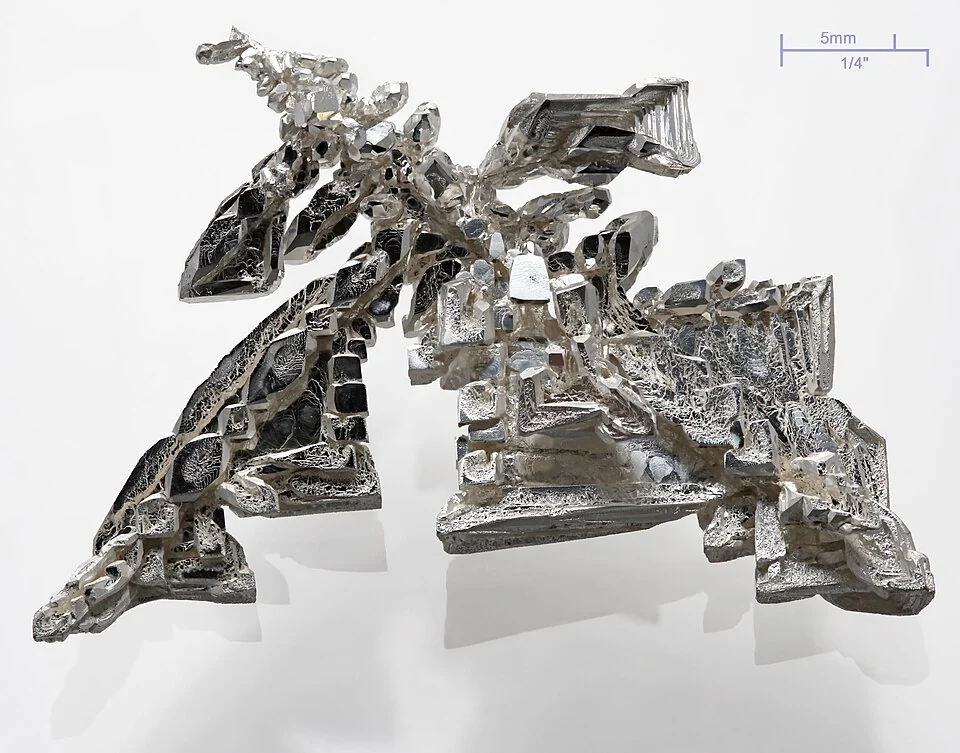
Synthetic made gold crystals by the chemical transport reaction in chlorine gas. Purity >99.99%

Granite specimen

Granite

Photographer / creator: Eurico Zimbres FGEL/UERJ

License: CC BY-SA 2.0 br

Original: File:Granite.jpg

Resized to at most 960 pixels and converted to WebP; no cropping.

Source credit and review

Source file page names Eurico Zimbres FGEL/UERJ as author and owner; CC BY-SA 2.0 Brazil.

Source description checked against the rock type; selected for visible hand-specimen texture. Museum inventory numbers are not identification labels.

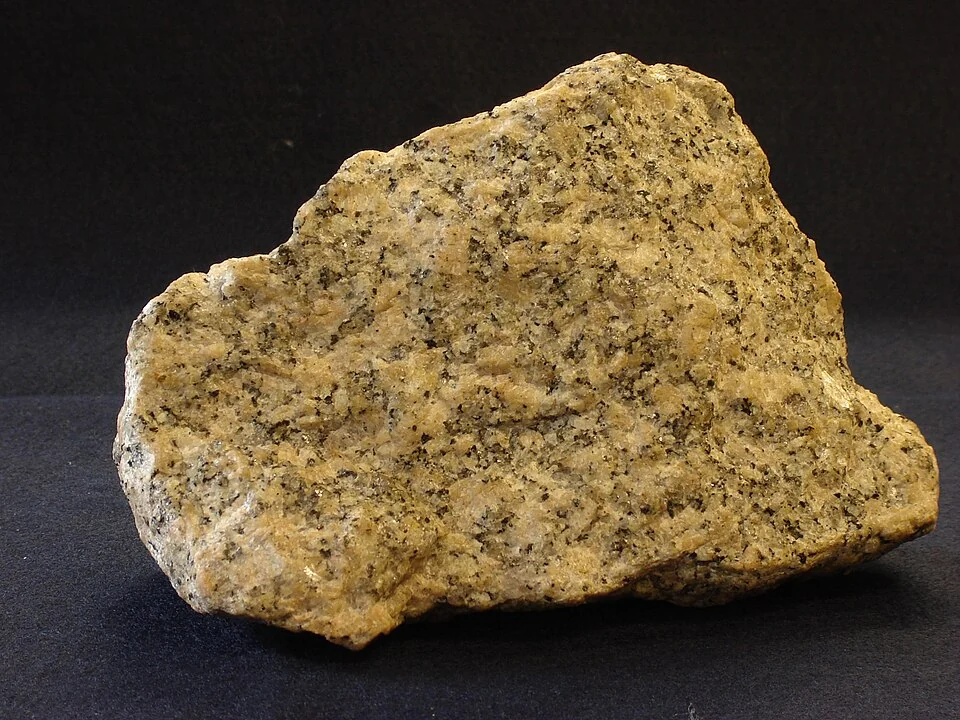
A hand specimen of granite, 15 × 17 cm, from Rio de Janeiro, Brazil. Created in 2005.

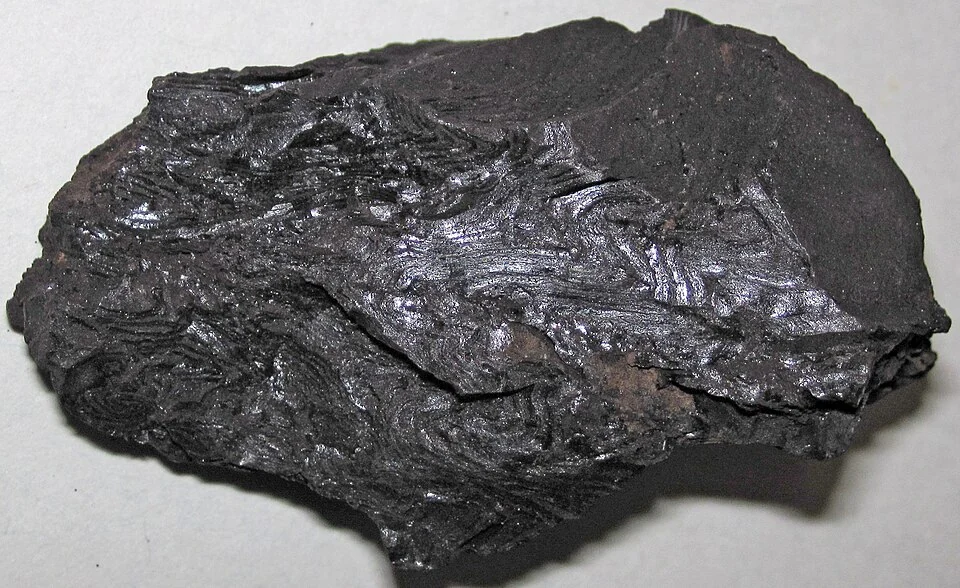
Graphite specimen

Graphite

Photographer / creator: Rob Lavinsky, iRocks.com – CC-BY-SA-3.0 · iRocks.com

License: CC BY-SA 3.0

Original: File:Graphite-233436.jpg

Resized to at most 960 pixels and converted to WebP; no cropping.

Source credit and review

http://www.mindat.org/photo-233436.html

Source description and visible appearance reviewed for specimen identity, diagnostic texture or crystal habit. Selected photo has no visible specimen-name label.

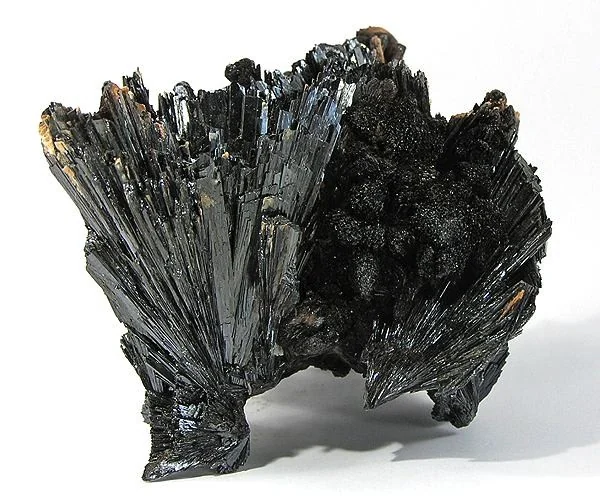
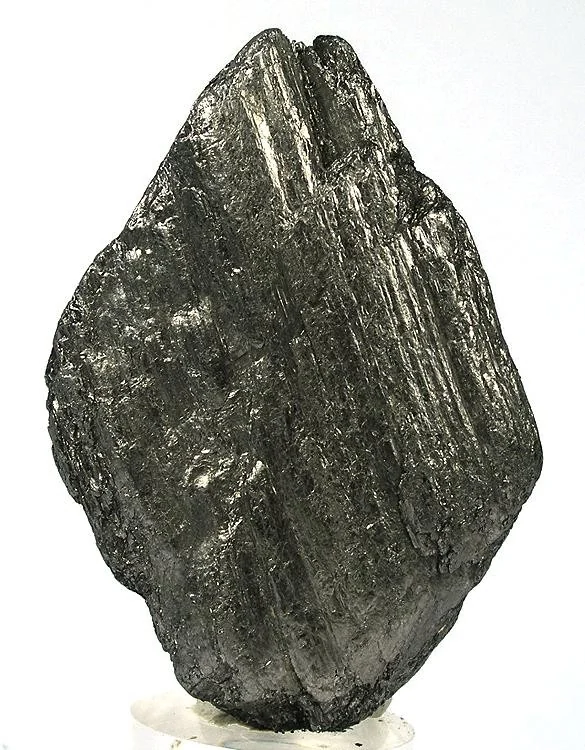
Graphite Locality: Old Beneis Farm, Marlborough , Cheshire County, New Hampshire , USA ( Locality at mindat.org ) Size: 5.6 x 3.8 x 1.8 cm. A large, solid mass of elemental carbon or graphite with the super, greasy/waxy feel and typical, sheet-like form. This splendent, steel-gray specimen is from a very uncommon New Hampshire locality - the old Beneis Farm, Marlborough, Cheshire County. Ex. Bob Whitmore Collection, a noted New England collector and field collector.

Greywacke specimen

Greywacke

Photographer / creator: Nessa Eull

License: CC0

Original: File:Graywacke (GeoDIL number - 477).jpg

Resized to at most 960 pixels and converted to WebP; no cropping.

Source credit and review

https://geodil.dperkins.org/h/477.html

Source description and full photograph reviewed for the correct material and visible diagnostic texture. No specimen-name label is visible.

Graywackes are “dirty” sandstones. That is, they are sandstones that are poorly sorted and contain significant amounts of rock fragments and clay besides the normal quartz. This sample is 9 cm across.

Grossular (green) specimen

Grossular (green)

Photographer / creator: Parent Géry

License: Public domain

Original: File:Grenat tsavorite(Madagascar).jpg

Resized to at most 960 pixels and converted to WebP; no cropping.

Source credit and review

Own work

Visual appearance and source description reviewed for the named mineral, variety or rock. Selected for visible diagnostic features; no specimen-name label is visible.

Tsavorite

Halite specimen

Halite

Photographer / creator: Lech Darski

License: CC BY-SA 4.0

Original: File:Halit (NaCl) - Kopalnia soli Wieliczka, Polska.jpg

Resized to at most 960 pixels and converted to WebP; no cropping.

Source credit and review

Own work

Source description and visible appearance reviewed for specimen identity, diagnostic texture or crystal habit. Selected photo has no visible specimen-name label.

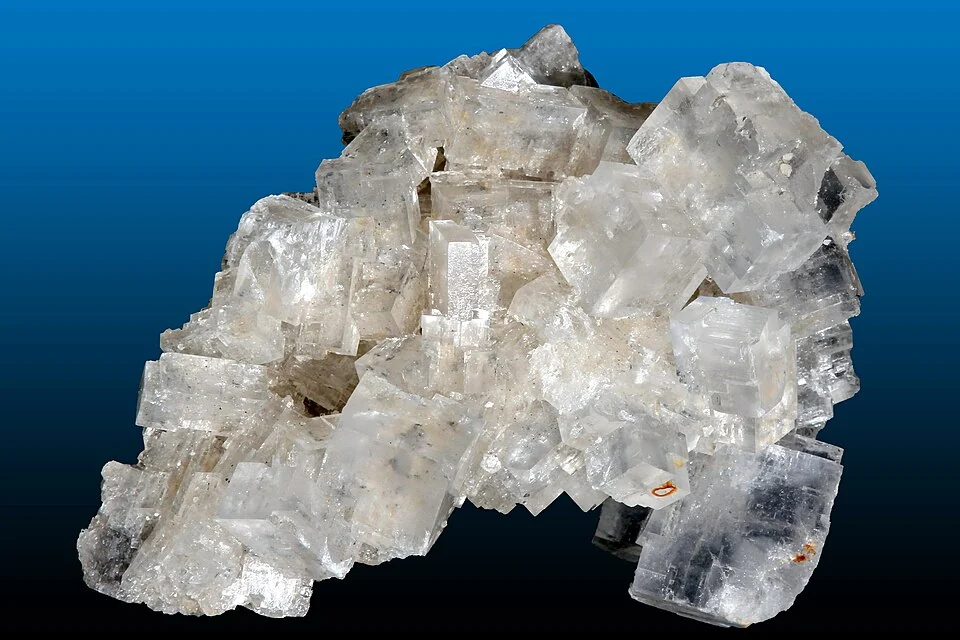
Halit (NaCl) - Kopalnia soli Wieliczka, Polska.

Hematite specimen

Hematite

Photographer / creator: Wikipedia Loves Art participant " Assignment_Houston_One "

License: CC BY-SA 2.5

Original: File:WLA hmns Hematite.jpg

Resized to at most 960 pixels and converted to WebP; no cropping.

Source credit and review

Uploaded from the Wikipedia Loves Art photo pool on Flickr

Visual appearance and source description reviewed for the named mineral, variety or rock. Selected for visible diagnostic features; no specimen-name label is visible.

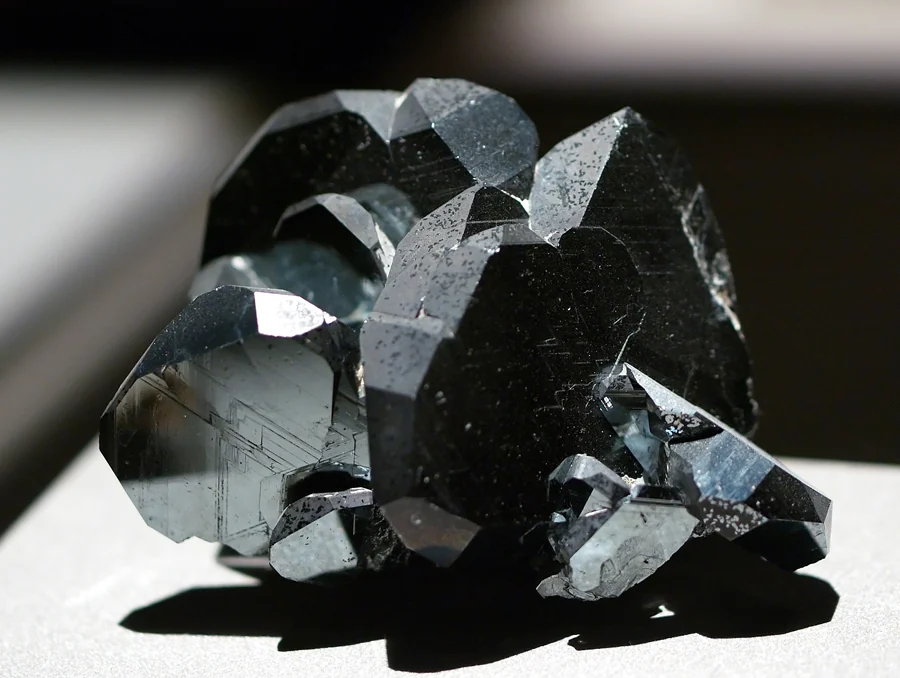
Hematite Trigonal iron oxide Ibitiara, Mina Gerais Brazil HMNS 5440 Wikipedia Loves Art at the Houston Museum of Natural Science This photo of item # 5440 at the Houston Museum of Natural Science was contributed under the team name " Assignment_Houston_One " as part of the Wikipedia Loves Art project in February 2009. Houston Museum of Natural Science The original photograph on Flickr was taken by sulla55 — please add a comment to the original Flickr page whenever a use has been made on Wikipedia or another project. Project galleries on Flickr: this institution , this team

Hornblende specimen

Hornblende

Photographer / creator: Rob Lavinsky, iRocks.com – CC-BY-SA-3.0 · iRocks.com

License: CC BY-SA 3.0

Original: File:Apatite-(CaOH)-Hornblende-38354.jpg

Resized to at most 960 pixels and converted to WebP; no cropping.

Source credit and review

http://www.mindat.org/photo-38354.html

Visual appearance and source description reviewed for the named mineral, variety or rock. Selected for visible diagnostic features; no specimen-name label is visible.

Apatite-(CaOH) , Hornblende Locality: Oksøyekollen (Oksøykollen; Oxøiekollen), Snarum, Modum , Buskerud , Norway ( Locality at mindat.org ) Not only a VERY uncommon specimen (a crystal of Norwegian apatite attached to a euhedral crystal of hornblende), but it came with an old label from 1868 on which it is erroneously named "chlorapatite" - the bottom line says: Univ. min. inst.: Elling Gerthus, 1868. This is a wonderful locality piece and a piece of history at the same time. either crystal alone is GREAT for the locale! Hornblende crystals of such sharpness are not common. 3.5 x 3.4 x 1.5 cm

Jasper specimen

Jasper

Photographer / creator: Tommy from Arad

License: CC BY 2.0

Original: File:Jasper outcrop in the Bucegi Mountains.jpg

Resized to at most 960 pixels and converted to WebP; no cropping.

Source credit and review

Jasper

Source description checked against the specimen; visual review confirms a usable crystal, aggregate or rock exposure without a specimen-name label.

Bucegi mountains Romania

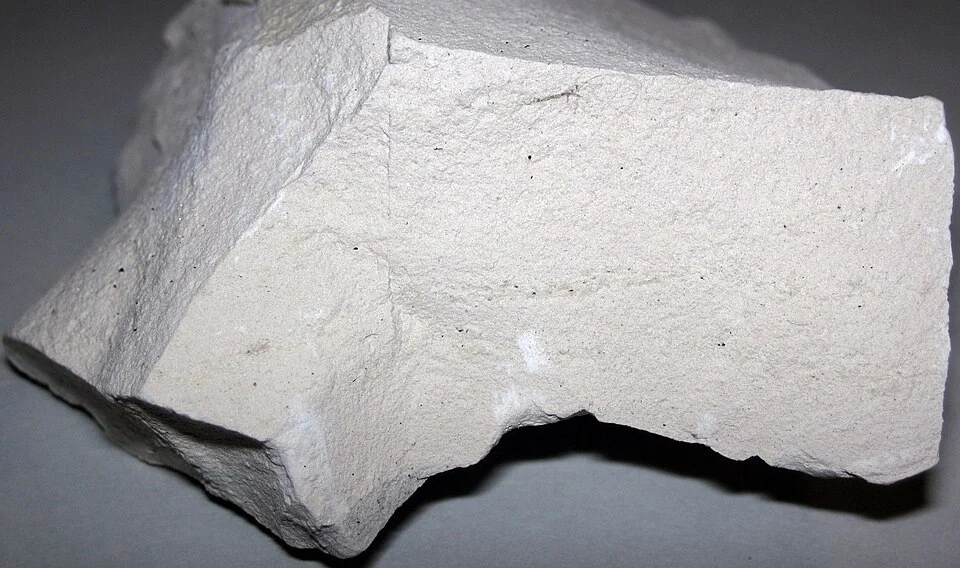
Kaolinite specimen

Kaolinite

Photographer / creator: James St. John https://www.flickr.com/people/jsjgeology?rb=1

License: CC BY 2.0

Original: File:Kaolinite from Twiggs County in Georgia in USA.jpg

Resized to at most 960 pixels and converted to WebP; no cropping.

Source credit and review

https://www.flickr.com/photos/jsjgeology/32350111650/

Source description and visible appearance reviewed for specimen identity, diagnostic texture or crystal habit. Selected photo has no visible specimen-name label.

Kaolinite sample from Twiggs County, Georgia, USA. This sample is from the Cretaceous rocks of Georgia, where it occurs as lenses in paleodeltaic sands.

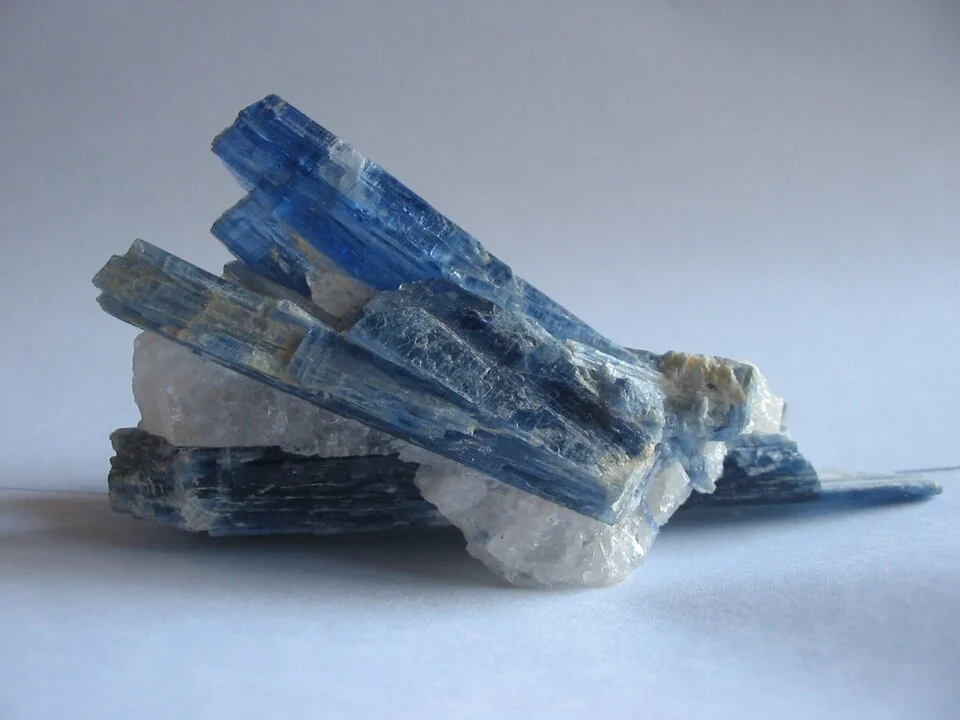
Kyanite specimen

Kyanite

Photographer / creator: User:Aelwyn

License: CC BY-SA 3.0

Original: File:Kyanite crystals.jpg

Resized to at most 960 pixels and converted to WebP; no cropping.

Source credit and review

Self made picture

Source description and visible appearance reviewed for specimen identity, diagnostic texture or crystal habit. Selected photo has no visible specimen-name label.

Kyanite crystals (7cm long)

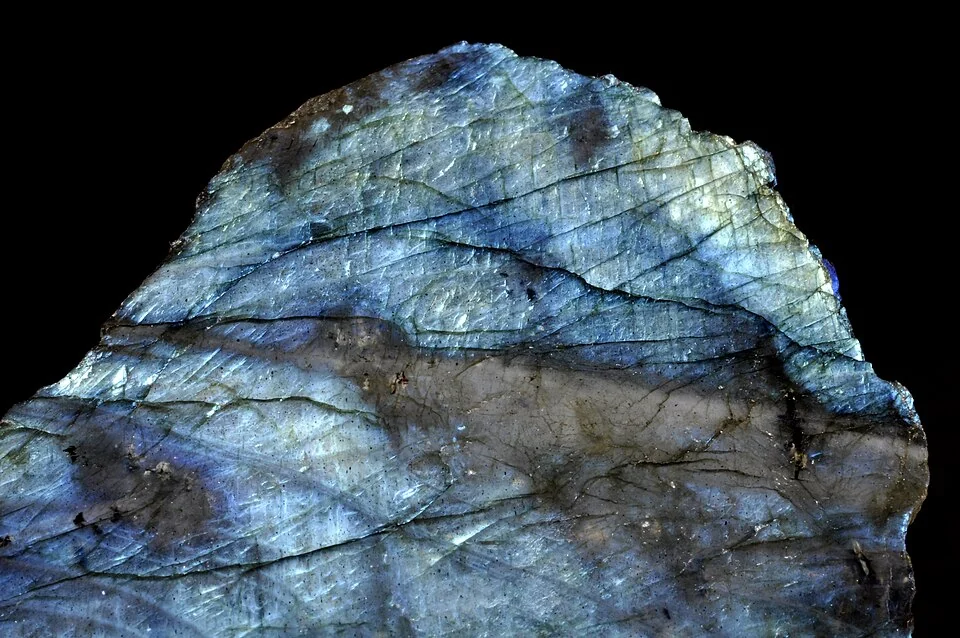
Labradorite specimen

Labradorite

Photographer / creator: Parent Géry

License: Public domain

Original: File:Labradorite polie 3(Madagascar).jpg

Resized to at most 960 pixels and converted to WebP; no cropping.

Source credit and review

Own work

Source description and visible appearance reviewed for specimen identity, diagnostic texture or crystal habit. Selected photo has no visible specimen-name label.

Labradorite

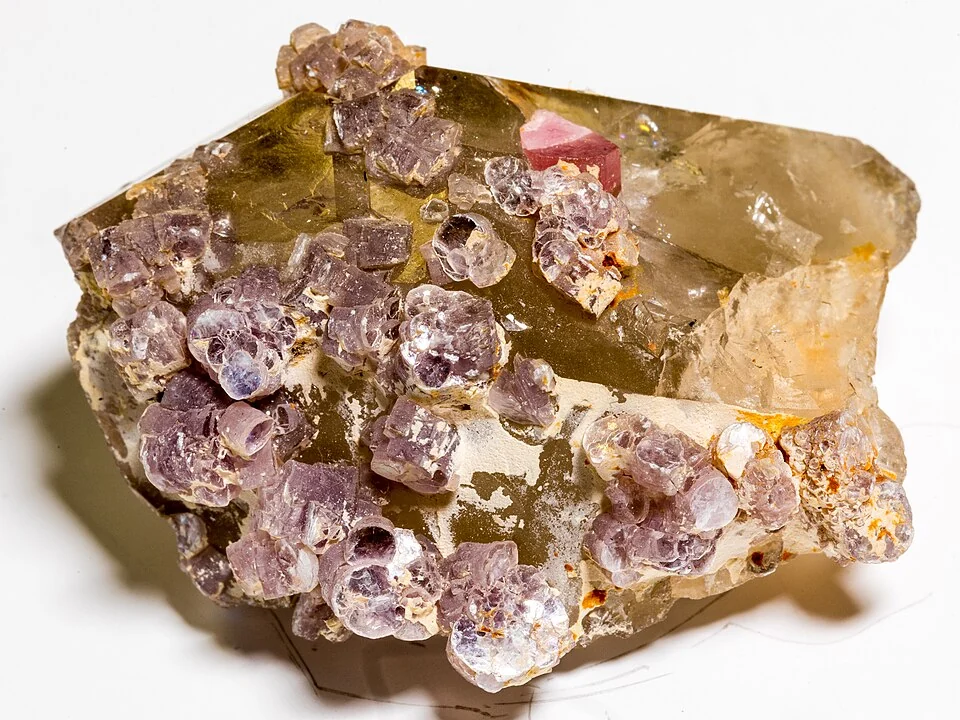
Lepidolite specimen

Lepidolite

Photographer / creator: © Raimond Spekking / CC BY-SA 4.0 (via Wikimedia Commons)

License: CC BY-SA 4.0

Original: File:Lepidolite, Quartz, Elbaite. Himalaya Mine, Mesa Grande, California, USA-9023.jpg

Resized to at most 960 pixels and converted to WebP; no cropping.

Source credit and review

Own work

Visual appearance and source description reviewed for the named mineral, variety or rock. Selected for visible diagnostic features; no specimen-name label is visible.

Lepidolite and Elbaite variety Rubellite on Quartz – Place of discovery: Himalaya Mine, Mesa Grande, California, USA

Lignite specimen

Lignite

Photographer / creator: James St. John

License: CC BY 2.0

Original: File:Lignite coal (Fort Union Formation, Paleocene; Bowman area, North Dakota, USA) 13.jpg

Resized to at most 960 pixels and converted to WebP; no cropping.

Source credit and review

https://www.flickr.com/photos/47445767@N05/53566037907/

Visual appearance and source description reviewed for the named mineral, variety or rock. Selected for visible diagnostic features; no specimen-name label is visible.

Lignite coal from the Tertiary of North Dakota, USA. Lignite coal is a low rank of coal. It is lightweight, brown to black colored, soft, friable, sooty, may have visible plant fragments, and burns in a fire (it's a fossil fuel). Lignite crumbles when dried out and can spontaneously ignite. Compositionally, lignite coal has 25 to 35% carbon content. When burned, lignite is sooty; relatively little heat is generated compared with higher ranks of coal. Stratigraphy: Fort Union Formation (also known as the Fort Union Group), Upper Paleocene Locality: unrecorded / undisclosed site at or near the town of Bowman, southwestern North Dakota, USA Info. at: en.wikipedia.org/wiki/Lignite

Magnesite specimen

Magnesite

Photographer / creator: James St. John

License: CC BY 2.0

Original: File:Magnesite (Windous Magnesite Deposit, Tertiary; Westvaco Chlorine Products mine, southwest of Ely, Nevada, USA) 10.jpg

Resized to at most 960 pixels and converted to WebP; no cropping.

Source credit and review

https://www.flickr.com/photos/47445767@N05/52413942586/

Source description checked against the specimen; visual review confirms a usable crystal, aggregate or rock exposure without a specimen-name label.

Magnesite rock from the Tertiary of Nevada, USA. Magnesite is a magnesium carbonate mineral (MgCO3). It is the end member of a chemical continuum with dolomite (CaMg(CO3)2) and calcite (CaCO3). It often forms coarsely-crystalline masses or chalky / earthy masses. It has a nonmetallic luster and can be any color, but is often whitish. It has a white streak, a hardness of about 3.5 to 4.5, and rhombohedral cleavage. Magnesite is usually the result of metamorphic chemical alteration of Mg-bearing rocks such as peridotites and serpentinites by the action of carbonic acid-rich fluids. Seen here is earthy magnesite from an inactive magnesite mine in eastern Nevada's Currant Creek District. Published studies indicate that magnesite in the area formed by hydrothermal alteration / replacement of volcanic tuff beds in the Tertiary-aged Currant Tuff. Locality: Westvaco Chlorine Products mine (inactive), southeast of Windous Butte, northeastern Currant Creek Magnesite District, southwest of the town of Ely, eastern Nevada, USA (apparently in the vicinity of 38° 55' 41.85" North latitude, 115° 09' 43.08" West longitude) Some info. from: Faust & Callaghan (1948) - Mineralogy and petrology of the Currant Creek magnesite deposits and associated rocks of Nevada. Bulletin of the Geological Society of America 59: 11-74. Photo gallery of magnesite: www.mindat.org/gallery.php?min=2482

Magnetite specimen

Magnetite

Photographer / creator: Rob Lavinsky, iRocks.com – CC-BY-SA-3.0 · iRocks.com

License: CC BY-SA 3.0

Original: File:Magnetite-118736.jpg

Resized to at most 960 pixels and converted to WebP; no cropping.

Source credit and review

http://www.mindat.org/photo-118736.html

Visual appearance and source description reviewed for the named mineral, variety or rock. Selected for visible diagnostic features; no specimen-name label is visible.

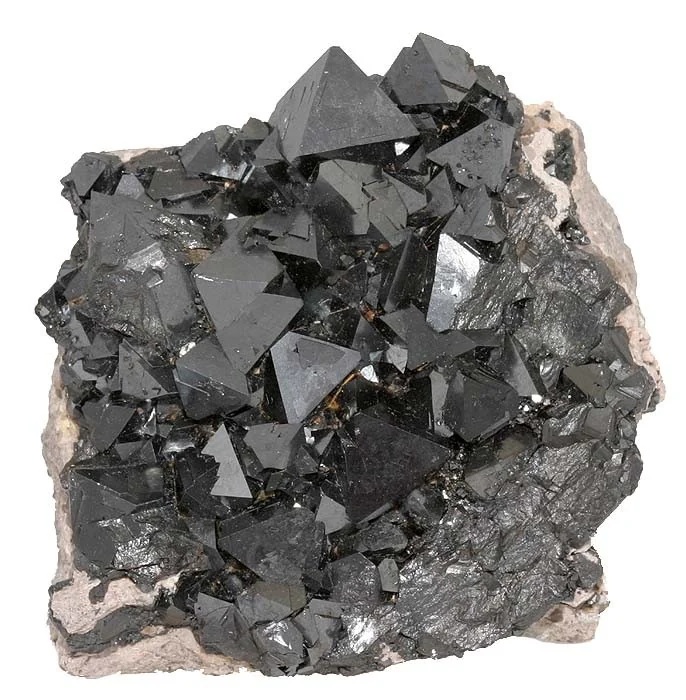
Magnetite Locality: Cerro Huañaquino, Potosí Department , Bolivia ( Locality at mindat.org ) Size: 6 x 5.8 x 2.6 cm. A recent batch of magnetite specimens from Bolivia was exceptional in the size of the crystals, their sharpness and luster, and the absence of the typical corroded, oxidized crystals that can sometimes detract. These crystals measure to over 1 cm on edge, 1.5 cm tip-to-tip.

Malachite specimen

Malachite

Photographer / creator: JJ Harrison ( https://www.jjharrison.com.au/ )

License: CC BY-SA 3.0

Original: File:Malachite, Zaire.jpg

Resized to at most 960 pixels and converted to WebP; no cropping.

Source credit and review

Own work

Source description and visible appearance reviewed for specimen identity, diagnostic texture or crystal habit. Selected photo has no visible specimen-name label.

Malachite, Zaire

Marble specimen

Marble

Photographer / creator: Nessa Eull

License: CC0

Original: File:Marble (GeoDIL number - 506).jpg

Resized to at most 960 pixels and converted to WebP; no cropping.

Source credit and review

https://geodil.dperkins.org/h/506.html

Compared source description and visible specimen features; selected a representative crystal, aggregate or rock texture rather than an associated mineral or landscape.

This 10 cm wide marble sample is from the Adirondack lowlands in upstate New York. It is nearly 100% calcite, but close examination reveals a few brown flakes of phlogopite and some silvery specks of graphite. Some marbles contain conspicuous metamorphic minerals. This one does not because it formed from metamorphism of a limestone that contained little but calcite, so the chemical components needed to form new metamorphic minerals were not present.

Mica Schist specimen

Mica Schist

Photographer / creator: Mike Davis

License: CC0

Original: File:Mica schist (GeoDIL number - 425).jpg

Resized to at most 960 pixels and converted to WebP; no cropping.

Source credit and review

https://geodil.dperkins.org/h/425.html

Source identity checked; selected for visible cleavage, foliation, massive texture or tabular crystal habit. No specimen-name label is visible.

This is a fine grained schist that has been deformed and now contains “wavy” layers. Although no minerals can be seen in hand specimen, a microscope reveals biotite, chlorite, muscovite and quartz. This sample is 10 cm across.

Milky Quartz specimen

Milky Quartz

Photographer / creator: Jan Helebrant

License: CC BY-SA 2.0

Original: File:Milky quartz - SiO2 locality - Příbram, Czech Republic (50606633676).jpg

Resized to at most 960 pixels and converted to WebP; no cropping.

Source credit and review

IMGP2021006

Visual appearance and source description reviewed for the named mineral, variety or rock. Selected for visible diagnostic features; no specimen-name label is visible.

milky quartz - SiO2 locality: Příbram, Czech Republic photo (c) 2020 Jan Helebrant <a href=" http://www.juhele.blogspot.com " rel="noreferrer nofollow">www.juhele.blogspot.com</a>

Muscovite specimen

Muscovite

Photographer / creator: Rob Lavinsky, iRocks.com – CC-BY-SA-3.0 · iRocks.com

License: CC BY-SA 3.0

Original: File:Muscovite-Albite-122887.jpg

Resized to at most 960 pixels and converted to WebP; no cropping.

Source credit and review

http://www.mindat.org/photo-122887.html

Visual appearance and source description reviewed for the named mineral, variety or rock. Selected for visible diagnostic features; no specimen-name label is visible.

Muscovite , Albite (Var.: Cleavelandite ) Locality: Divino das Laranjeiras , Doce valley, Minas Gerais , Southeast Region, Brazil ( Locality at mindat.org ) Size: 6 x 5.3 x 3.9 cm. Muscovite is almost always seen as an "accessory" mineral - except on rare occasions, as with this gorgeous specimen. The bladed crystals are bright pearly silver, in a complex intergrowth, with euhedral cleavelandites playing the role of accents on this specimen. Ex. Feist Collection.

Obsidian specimen

Obsidian

Photographer / creator: Mike Davis

License: CC0

Original: File:Obsidian (GeoDIL number - 413).jpg

Resized to at most 960 pixels and converted to WebP; no cropping.

Source credit and review

https://geodil.dperkins.org/h/413.html

Source description checked against the rock type; selected for visible hand-specimen texture. Museum inventory numbers are not identification labels.

Obsidian, volcanic glass, generally has a jet black color, but this sample is brown due to the presence of oxidized iron. Obsidian forms when magma cools so quickly that mineral crystals cannot form. This sample is 8 cm across.

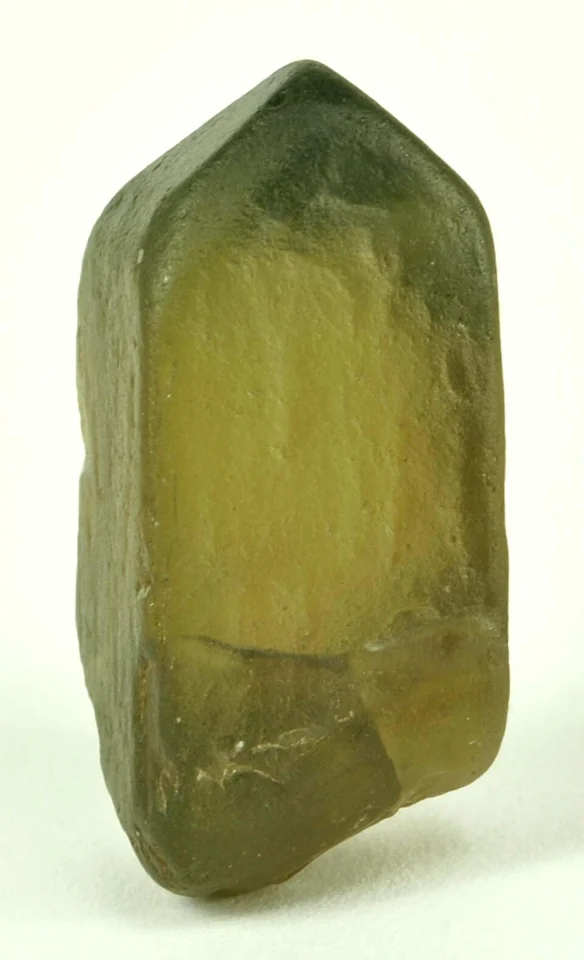
Olivine specimen

Olivine

Photographer / creator: Rob Lavinsky, iRocks.com – CC-BY-SA-3.0 · iRocks.com

License: CC BY-SA 3.0

Original: File:Olivine-gem7-10a.jpg

Resized to at most 960 pixels and converted to WebP; no cropping.

Source credit and review

Image: http://www.irocks.com/db_pics/pics/gem7-10a.jpg , Description: http://www.irocks.com/render.html?species=Olivine&page=0

Visual appearance and source description reviewed for the named mineral, variety or rock. Selected for visible diagnostic features; no specimen-name label is visible.

Olivine Locality: Naran-Kagan Valley, Kohistan District , North-West Frontier Province , Pakistan ( Locality at mindat.org ) Size: miniature, 3.4 x 2.5 x 1.9 cm (28 grams) This is from a new find of peridots (gem-grade olivine) at this now-classic locality which has produced the world's best crystals of the species by far. The crystal is very gemmy and translucent to transparent throughout. There are a few very insignificant dings, and one contact on the left side. It is otherwise complete all around.

Oolitic Limestone specimen

Oolitic Limestone

Photographer / creator: James St. John

License: CC BY-SA 4.0

Original: File:Oolitic limestone (Salem Limestone, Middle Mississippian; Bedford, Indiana, USA) 1.jpg

Resized to at most 960 pixels and converted to WebP; no cropping.

Source credit and review

Own work

Visual appearance and source description reviewed for the named mineral, variety or rock. Selected for visible diagnostic features; no specimen-name label is visible.

Oolitic limestone from the Mississippian of Indiana, USA. (public display, Geology Department, Wittenberg University, Springfield, Ohio, USA) Sedimentary rocks form by the solidification of loose sediments. Loose sediments become hard rocks by the processes of deposition, burial, compaction, dewatering, and cementation. There are three categories of sedimentary rocks: 1) Siliciclastic sedimentary rocks form by the solidification of sediments produced by weathering & erosion of any previously existing rocks. 2) Biogenic sedimentary rocks form by the solidification of sediments that were once-living organisms (plants, animals, micro-organisms). 3) Chemical sedimentary rocks form by the solidification of sediments formed by inorganic chemical reactions. Most sedimentary rocks have a clastic texture, but some are crystalline. Limestone is a common sedimentary rock composed of the mineral calcite (CaCO3), which bubbles in acid. Many geologically young limestones are composed of aragonite (also CaCO3). Numerous varieties of limestone exist (e.g., fine-grained limestone/micritic limestone/lime mudstone, coquina, chalk, wackestone, packstone, grainstone, rudstone, rubblestone, coralstone, calcarenite, calcisiltite, calcilutite, calcirudite, floatstone, boundstone, framestone, oolitic limestone, oncolitic limestone, etc.). Most limestones represent deposition in ancient warm, shallow ocean environments. Oolitic limestones are whitish to cream-colored limestones composed of sand-sized (1/16 to 2 mm in size), well rounded, concentrically-layered calcite or aragonite grains called oolites (also known as ooliths or ooids). Oolites form by rolling back and forth on a shallow seafloor, or sometimes on a shallow lake bed, by wave action. Oolites are forming today on the Bahamas Platform and in Great Salt Lake, Utah, USA. The technical geologic term for most oolitic limestones is “oolitic grainstone”. Uncertainty exists about the specifics of the origin of oolites. Some researchers conclude that oolites form by completely inorganic chemical precipitation of CaCO3 from water around some nucleus (a tiny shell or skeletal fragment or sediment grain). Other researchers conclude that the presence of bacterial films on oolite grain surfaces play a significant role in the precipitation of CaCO3 layers. However, the undoubted presence of bacteria does not necessarily indicate a biogenic origin for oolites - bacteria are everywhere. Stratigraphy: Salem Limestone, Middle Mississippian Locality: unrecorded/undisclosed site at or near the town of Bedford, Lawrence County, southern Indiana, USA
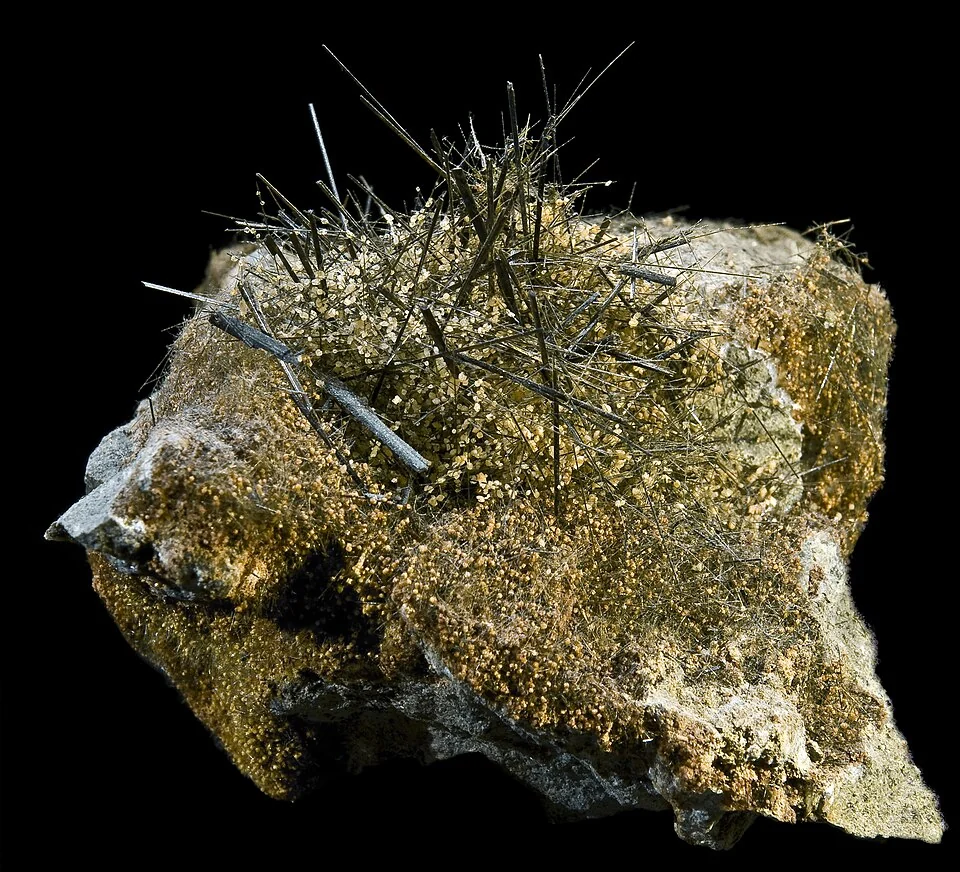
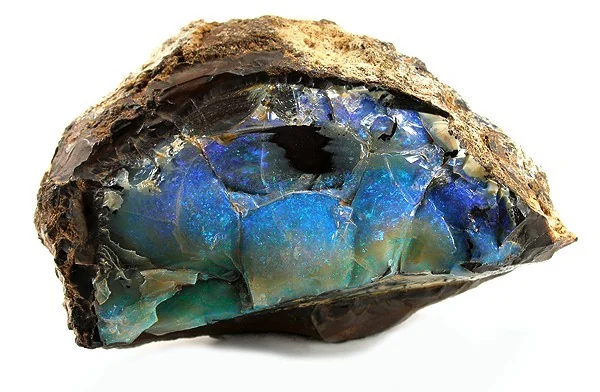
Opal specimen

Opal

Photographer / creator: Rob Lavinsky, iRocks.com – CC-BY-SA-3.0 · iRocks.com

License: CC BY-SA 3.0

Original: File:Opal-53714.jpg

Resized to at most 960 pixels and converted to WebP; no cropping.

Source credit and review

http://www.mindat.org/photo-53714.html

Visual appearance and source description reviewed for the named mineral, variety or rock. Selected for visible diagnostic features; no specimen-name label is visible.

Opal (Var.: Precious Opal) Locality: Queensland , Australia ( Locality at mindat.org ) A rich seam of wonderfully irridescent opal, flashing gold and blue fire, encased in matrix! This is a very large and striking opal specimen. The layer of precious opal is a good 0.5 cm thick, and under it is a thick layer of common opal. Its from the central Queensland opalfield, perhaps the Quilpie or Yowah area. How do we know? Thanks to a friend over there who provided the following details: The matrix is an brown iron-stone or jasper-like rock, which is characteristic of the Queensland stuff. Coober Pedy opal is always hosted in white to greyish clay rich sandstone (usually quite fragile), kaolin or very rarely pale white/grey cherts. You just do not get those brown jasperoid nodules in Coober Pedy. In the Yowah area of Queenland that they are called Yowah Nuts and they are more like a septarian nodule with the cracks filled with precious opal. Also the opal has a characteristic blue background which you do not really get at Coober Pedy. 11.0 x 7.2 x 4.8cm

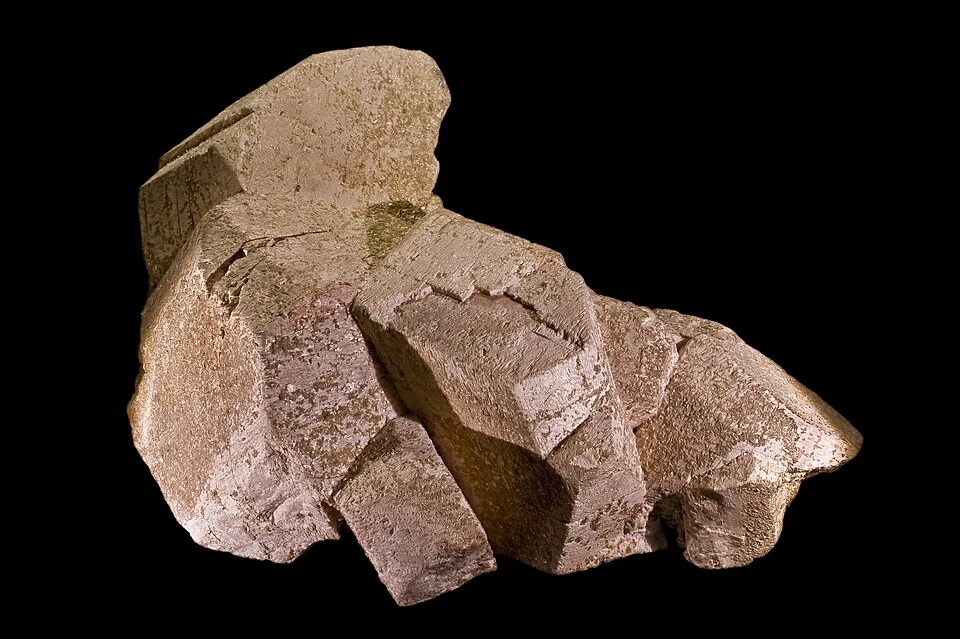
Orthoclase/Microcline specimen

Orthoclase/Microcline

Photographer / creator: Didier Descouens

License: CC BY-SA 4.0

Original: File:OrthoclaseBresil.jpg

Resized to at most 960 pixels and converted to WebP; no cropping.

Source credit and review

Own work

Source description and visible appearance reviewed for specimen identity, diagnostic texture or crystal habit. Selected photo has no visible specimen-name label.

Orthoclase Locality : Minas Gerais, Southeast Region, Brazil Size : (27x17cm)

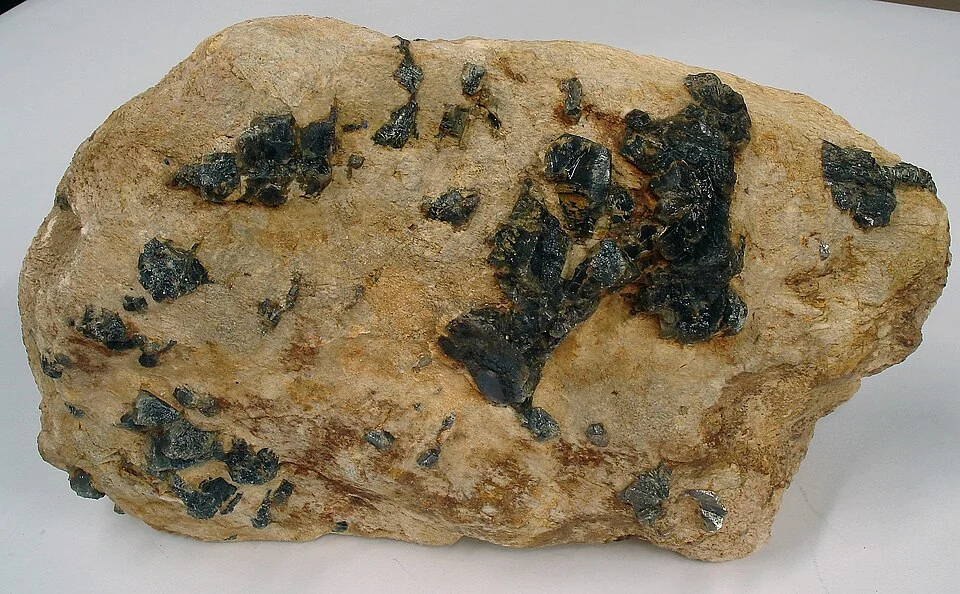
Pegmatite specimen

Pegmatite

Photographer / creator: No machine-readable author provided. Zimbres assumed (based on copyright claims).

License: CC BY-SA 2.5

Original: File:Alkaline pegmatite.jpg

Resized to at most 960 pixels and converted to WebP; no cropping.

Source credit and review

No machine-readable source provided. Own work assumed (based on copyright claims).

Visual appearance and source description reviewed for the named mineral, variety or rock. Selected for visible diagnostic features; no specimen-name label is visible.

Alkaline pegmatite Description: weathered feldspar and blue corundum crystals. Sample size: 35 x 15 cm. Origin:Canaã alkaline massif, Rio de Janeiro, Brazil Date:24/03/2006 Author:Eurico Zimbres Free for all use

Peridotite specimen

Peridotite

Photographer / creator: Nessa Eull

License: CC0

Original: File:Peridotite (GeoDIL number - 465).jpg

Resized to at most 960 pixels and converted to WebP; no cropping.

Source credit and review

https://geodil.dperkins.org/h/465.html

Source description checked against the rock type; selected for visible hand-specimen texture. Museum inventory numbers are not identification labels.

Ward’s Scientific calls this rock a peridotite, but it is highly altered and is mostly composed of serpentine and calcite now. The texture suggests that it was once a pyroxenite, although the exact kind of pyroxene cannot be determined. Peridotite is a general term used to describe coarse grained plutonic rocks dominated by olivine, but no hint of olivine can be seen in this sample, except that serpentine is one of the typical alteration products of olivine. 8.5 cm across.

Phyllite specimen

Phyllite

Photographer / creator: Mike Davis

License: CC0

Original: File:Phyllite (GeoDIL number - 423).jpg

Resized to at most 960 pixels and converted to WebP; no cropping.

Source credit and review

https://geodil.dperkins.org/h/423.html

Source identity checked; selected for visible cleavage, foliation, massive texture or tabular crystal habit. No specimen-name label is visible.

This is a very fine grained metamorphic rock. It is termed a phyllite because it is foliated and has a shiny/silky sheen to its surface. Even in thin section, the only major mineral that can be identified is quartz, but the shiny appearance suggests the presence of fine grained micas. This sample is 9.5 cm across.

Prehnite specimen

Prehnite

Photographer / creator: Ivar Leidus

License: CC BY-SA 4.0

Original: File:Prehnite - Southbury, Connecticut, USA.jpg

Resized to at most 960 pixels and converted to WebP; no cropping.

Source credit and review

Own work

Visual appearance and source description reviewed for the named mineral, variety or rock. Selected for visible diagnostic features; no specimen-name label is visible.

Prehnite (4.0 × 3.5 × 2.0 cm) from Southbury, Connecticut, USA

Pumice specimen

Pumice

Photographer / creator: Joseph H. Hartman

License: CC0

Original: File:Pumice (GeoDIL number - 50).jpg

Resized to at most 960 pixels and converted to WebP; no cropping.

Source credit and review

https://geodil.dperkins.org/h/50.html

Source description checked against the rock type; selected for visible hand-specimen texture. Museum inventory numbers are not identification labels.

This specimen is composed of fine whitish glass and many vesicles. Microscope examination shows it to have a rather eveny texture with strong orientation of elongate glass particles intermixed with spheroidal and irregular turbid dark glass pieces. A few spherulites have crystallized. This sample is 11.5 cm across.

Pyrite specimen

Pyrite

Photographer / creator: Ivar Leidus

License: CC BY-SA 4.0

Original: File:Pyrite - Huanzala mine, Huallanca, Bolognesi, Ancash, Peru.jpg

Resized to at most 960 pixels and converted to WebP; no cropping.

Source credit and review

Own work

Source description and visible appearance reviewed for specimen identity, diagnostic texture or crystal habit. Selected photo has no visible specimen-name label.

Cubic crystals of pyrite (7.0 × 5.0 × 2.5 cm). Found from Huanzala mine, Huallanca, Bolognesi, Ancash, Peru

Pyrolusite specimen

Pyrolusite

Photographer / creator: Unknown author Unknown author

License: Public domain

Original: File:Pyrolusite - USGS ID Stose, GW 1425.jpg

Resized to at most 960 pixels and converted to WebP; no cropping.

Source credit and review

http://libraryphoto.cr.usgs.gov/cgi-bin/show_picture.cgi?ID=ID.%20Stose,%20G.W.%201425

Source description checked against the specimen; visual review confirms a usable crystal, aggregate or rock exposure without a specimen-name label.

Pyrolusite and wad - B, earthy compact wad traversed by a sigmoid band that is of similar composition but has a rod like comb structure and radiate arrangement (the wad apparently is the process of changing to a compact and rod like psilomelane), from Doe Valley mine. Johnson County, Tennessee 1918. Plate 9-B in U.S. Geological Survey Bulletin 737. 1923.

Pyromorphite specimen

Pyromorphite

Photographer / creator: Ivar Leidus

License: CC BY-SA 4.0

Original: File:Pyromorphite - Santa Eufemia, Cordoba, Spain.jpg

Resized to at most 960 pixels and converted to WebP; no cropping.

Source credit and review

Own work

Source description checked against the specimen; visual review confirms a usable crystal, aggregate or rock exposure without a specimen-name label.

Pyromorphite (3.5 × 3.0 × 1.5 cm) from Resuperferolitica Mine, Minas Viejas, Santa Eufemia, Cordoba, Andalusia, Spain

Quartz Sandstone specimen

Quartz Sandstone

Photographer / creator: Huhulenik

License: CC BY 3.0

Original: File:Quartz Sandstone Geopark.jpg

Resized to at most 960 pixels and converted to WebP; no cropping.

Source credit and review

Own work

Visual appearance and source description reviewed for the named mineral, variety or rock. Selected for visible diagnostic features; no specimen-name label is visible.

Quartz Sandstone in geopark in botanic garden on Albertov, Prague, Czech Republic

Quartzite specimen

Quartzite

Photographer / creator: James St. John

License: CC BY 2.0

Original: File:Quartzite (Archean; Hellroaring Plateau, Beartooth Mountains Montana, USA) (49143602783).jpg

Resized to at most 960 pixels and converted to WebP; no cropping.

Source credit and review

Quartzite (Archean; Hellroaring Plateau, Beartooth Mountains Montana, USA)

Compared source description and visible specimen features; selected a representative crystal, aggregate or rock texture rather than an associated mineral or landscape.

Quartzite from the Precambrian of Montana, USA. (public display, Museum of the Rockies, Bozeman, Montana, USA) Quartzite is a crystalline-textured, quartzose rock. They form by intermediate- to high-grade metamorphism of quartzose sandstones or siltstones. The term "quartzite" has also been applied to very hard, very well-cemented quartzose sandstones that have not undergone metamorphism. Metamorphic quartzite is sometimes called "metaquartzite" to prevent confusion. The quartzite seen here is from Montana's Beartooth Mountains, where Archean-aged rocks are common - these are some of the oldest rocks on Earth. From exhibit signage: Look for the small, brownish red minerals in this quartzite. These zircons formed in this specimen 3.96 billion years ago, an indication that some of the oldest rock in North America can be found in the Beartooth Mountains. Locality: unrecorded/undisclosed site on the Hellroaring Plateau, Beartooth Mountains, southern Montana, USA
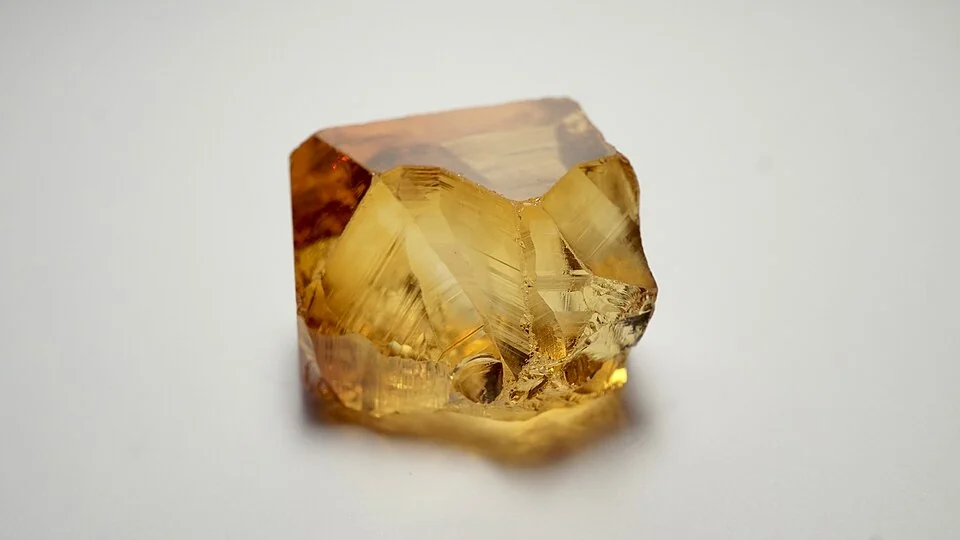
Rhodochrosite specimen

Rhodochrosite

Photographer / creator: JJ Harrison ( https://www.jjharrison.com.au/ )

License: CC BY-SA 4.0

Original: File:Rhodochrosite on Matrix - Peru.jpg

Resized to at most 960 pixels and converted to WebP; no cropping.

Source credit and review

Own work

Source description checked against the specimen; visual review confirms a usable crystal, aggregate or rock exposure without a specimen-name label.

Rhodochrosite on Matrix from Peru. Size 4×2.5 cm.

Rhodonite specimen

Rhodonite

Photographer / creator: CarlesMillan

License: CC BY-SA 4.0

Original: File:8224M-rhodonite3.jpg

Resized to at most 960 pixels and converted to WebP; no cropping.

Source credit and review

Own work

Source description checked against the specimen; visual review confirms a usable crystal, aggregate or rock exposure without a specimen-name label.

Group of transparent, sharp, well-defined, bright pink rhodonite crystals, associated with more than a dozen colorless and bright quartz crystals, upon a matrix formed by brown to black sphalerite and minor pyrite. The entire specimen measures 53mm x 52mm x 40mm, and the main rhodonite crystals are approximately 10mm tall, 6mm wide, and 1mm thick. Mass: 112g. It comes from the 2007 find at the Chiurucu mine, where mining works stopped long ago, and not far from the famous Huanzala mine, in the district of Huallanca, Peru.

Rhyolite specimen

Rhyolite

Photographer / creator: Joseph H. Hartman

License: CC0

Original: File:Rhyolite (GeoDIL number - 52).jpg

Resized to at most 960 pixels and converted to WebP; no cropping.

Source credit and review

https://geodil.dperkins.org/h/52.html

Source description checked against the rock type; selected for visible hand-specimen texture. Museum inventory numbers are not identification labels.

This somewhat vesicular pyroclastic rock is a pinkish specimen with scattered phenocrysts of glassy quartz in a quartz-feldspar matrix. Although hard to see in hand specimen, the sample also contains euhedral sanidine tablets, biotite euhedra, subhedral to euhedral sodic plagioclase laths, a few magnetite crystals, and angular quartz pieces. The tan-brownish matrix consists of devitrified glass shards and cryptocrystalline dust.

Rock Crystal specimen

Rock Crystal

Photographer / creator: Didier Descouens

License: CC BY-SA 4.0

Original: File:Quartz Brésil.jpg

Resized to at most 960 pixels and converted to WebP; no cropping.

Source credit and review

Own work

Source description and visible appearance reviewed for specimen identity, diagnostic texture or crystal habit. Selected photo has no visible specimen-name label.

Quartz Location: Minas Gerais - Brasil Size : 18x15x13 cm

Rock Gypsum specimen

Rock Gypsum

Photographer / creator: Darla Sondrol

License: CC0

Original: File:Gypsum (alabaster) (GeoDIL number - 628).jpg

Resized to at most 960 pixels and converted to WebP; no cropping.

Source credit and review

https://geodil.dperkins.org/h/628.html

Massive gypsum (alabaster) photo reused for rock gypsum. The source list explicitly treats rock gypsum and gypsum as equivalent for identification.

Gypsum has many different appearances. Often it is massive and fine grained, and we call it alabaster. Fibrous varieties are called satin spar. Coarser, clear bladed varieties are called selenite. This sample of alabaster is about 10.5 cm across.

Rock Salt (Halite) specimen

Rock Salt (Halite)

Photographer / creator: Lech Darski

License: CC BY-SA 4.0

Original: File:Halit (NaCl) - Kopalnia soli Wieliczka, Polska.jpg

Resized to at most 960 pixels and converted to WebP; no cropping.

Source credit and review

Own work

Source description checked against the specimen; visual review confirms a usable crystal, aggregate or rock exposure without a specimen-name label.

Halit (NaCl) - Kopalnia soli Wieliczka, Polska.

Rose Quartz specimen

Rose Quartz

Photographer / creator: James St. John

License: CC BY 2.0

Original: File:Rose quartz 12.jpg

Resized to at most 960 pixels and converted to WebP; no cropping.

Source credit and review

https://www.flickr.com/photos/47445767@N05/53487840194/

Source description and visible appearance reviewed for specimen identity, diagnostic texture or crystal habit. Selected photo has no visible specimen-name label.

A mineral is a naturally-occurring, solid, inorganic, crystalline substance having a fairly definite chemical composition and having fairly definite physical properties. At its simplest, a mineral is a naturally-occurring solid chemical. Currently, there are over 5900 named and described minerals - about 200 of them are common and about 20 of them are very common. Mineral classification is based on anion chemistry. Major categories of minerals are: elements, sulfides, oxides, halides, carbonates, sulfates, phosphates, and silicates. The silicates are the most abundant and chemically complex group of minerals. All silicates have silica as the basis for their chemistry. "Silica" refers to SiO2 chemistry. The fundamental molecular unit of silica is one small silicon atom surrounded by four large oxygen atoms in the shape of a triangular pyramid - this is the silica tetrahedron - SiO4. Each oxygen atom is shared by two silicon atoms, so only half of the four oxygens "belong" to each silicon. The resulting formula for silica is thus SiO2, not SiO4. The simplest & most abundant silicate mineral in the Earth's crust is quartz (SiO2). All other silicates have silica + impurities. Many silicates have a significant percentage of aluminum (the aluminosilicates). Quartz (silicon dioxide/silica - SiO2) is the most common mineral in the Earth's crust. It is composed of the two most abundant elements in the crust - oxygen and silicon. It has a glassy, nonmetallic luster, is commonly clearish to whitish to grayish in color, has a white streak, is quite hard (H≡7), forms hexagonal crystals, has no cleavage, and has conchoidal fracture. Quartz can be any color: clear, white, gray, black, brown, pink, red, purple, blue, green, orange, etc. The pink coloration of rose quartz has been attributed to the presence of Ti+4 impurity or the presence of dumortierite-like fibers. Some rose quartz coloration has been attributed to radiation bombardment of quartz having Al and P impurities. Photo gallery of quartz and rose quartz: www.mindat.org/gallery.php?min=3337 and www.mindat.org/gallery.php?min=3456

Rutile specimen

Rutile

Photographer / creator: Nessa Eull

License: CC0

Original: File:Rutile (GeoDIL number - 1564).jpg

Resized to at most 960 pixels and converted to WebP; no cropping.

Source credit and review

https://geodil.dperkins.org/h/1564.html

Source description and full photograph reviewed for the correct material and visible diagnostic texture. No specimen-name label is visible.

Rutile, TiO2 (titanium oxide), is an interesting, varied and important mineral. Rutile is a major ore of titanium, a metal used for high tech alloys because of its light weight, high strength and resistance to corrosion.

Satin Spar specimen

Satin Spar

Photographer / creator: James St. John

License: CC BY 2.0

Original: File:Satin spar gypsum (Cropwell Bishop Formation, Lower Triassic; near Derby, England) 1.jpg

Resized to at most 960 pixels and converted to WebP; no cropping.

Source credit and review

https://www.flickr.com/photos/47445767@N05/53528764903/

Source description and visible appearance reviewed for specimen identity, diagnostic texture or crystal habit. Selected photo has no visible specimen-name label.

Gypsum from the Triassic of England. A mineral is a naturally-occurring, solid, inorganic, crystalline substance having a fairly definite chemical composition and having fairly definite physical properties. At its simplest, a mineral is a naturally-occurring solid chemical. Currently, there are over 6000 named and described minerals - about 200 of them are common and about 20 of them are very common. Mineral classification is based on anion chemistry. Major categories of minerals are: elements, sulfides, oxides, halides, carbonates, sulfates, phosphates, and silicates. The sulfate minerals all have one or more sulfate anions (SO4 -2). Gypsum is a moderately common hydrous calcium sulfate mineral (CaSO4·2H2O). Gypsum has a nonmetallic luster, is usually clearish to whitish, is soft (H≡2), and rather fragile/brittle. Gypsum has 3 cleavage planes, one of which is well developed (“one good cleavage), and the other two are not well developed (“two poor cleavages”). Broken gypsum specimens are frequently thin plates - the consequence of the one good cleavage plane. Unbroken crystals show monoclinic symmetry. Gypsum has economic value as a mineral. It is the starting ingredient for making plaster and wallboard. Translucent rock gypsum ("alabaster") has been carved to make decorative objects. The sample seen here is composed of numerous, tightly-packed gypsum fibers - such specimens are nicknamed "satin spar gypsum". It comes from an evaporite interval in an otherwise siliciclastics-dominated succession of Triassic-aged sedimentary rocks in central England. Stratigraphy: Cropwell Bishop Formation, upper Mercia Mudstone Group (a.k.a. "Keuper Marl"), Lower Triassic Locality: unrecorded / undisclosed site (probably an old quarry or mine) near the town of Derby, central England Photo gallery of gypsum: www.mindat.org/gallery.php?min=1784

Scoria specimen

Scoria

Photographer / creator: ScoriaPumice

License: CC0

Original: File:Basaltic scoria (Holocene, Taal 1754 eruption).jpg

Resized to at most 960 pixels and converted to WebP; no cropping.

Source credit and review

Own work

Visual appearance and source description reviewed for the named mineral, variety or rock. Selected for visible diagnostic features; no specimen-name label is visible.

Basaltic scoria lapillus from the 1754 eruption of Taal. Collected near the shore of Taal Lake.

Selenite specimen

Selenite

Photographer / creator: Twyla Baker

License: CC0

Original: File:Selenite (GeoDIL number - 944).jpg

Resized to at most 960 pixels and converted to WebP; no cropping.

Source credit and review

https://geodil.dperkins.org/h/944.html

Visual appearance and source description reviewed for the named mineral, variety or rock. Selected for visible diagnostic features; no specimen-name label is visible.

Selenite is a clear, generally colorless, variety of gypsum. Large selenite “sheets” are found in many places in Utah. Gypsum, CaSO4•2H2O, is a relatively common mineral that comes in many varieties. Selenite denotes the clear crystal variety. Alabaster is a name for granular, massive gypsum. Fibrous gypsum is called satin spar. This blade, really a cleavage fragment from a larger crystal, is 32 cm long.

Serpentinite specimen

Serpentinite

Photographer / creator: Gabriel HM

License: CC BY-SA 4.0

Original: File:Serpentinite sur gneiss.jpg

Resized to at most 960 pixels and converted to WebP; no cropping.

Source credit and review

Own work

Source description checked against the specimen; visual review confirms a usable crystal, aggregate or rock exposure without a specimen-name label.

Bloc de Serpentinite (Savoie)

Shale specimen

Shale

Photographer / creator: Chris Woodrich

License: CC BY-SA 4.0

Original: File:Shale formation, Marble Canyon, Kootenay National Park, British Columbia, 2025-07-11.jpg

Resized to at most 960 pixels and converted to WebP; no cropping.

Source credit and review

Own work

Source description checked against the specimen; visual review confirms a usable crystal, aggregate or rock exposure without a specimen-name label.

Shale formation, Marble Canyon, Kootenay National Park, British Columbia, Canada, 2025-07-11

Siderite specimen

Siderite

Photographer / creator: DerHexer, Wikimedia Commons, CC-by-sa 4.0

License: CC BY-SA 4.0

Original: File:Harvard Museum of Natural History. Siderite. Gilman, Eagle Co., CO (DerHexer) 2012-07-20.jpg

Resized to at most 960 pixels and converted to WebP; no cropping.

Source credit and review

Own work

Source description checked against the specimen; visual review confirms a usable crystal, aggregate or rock exposure without a specimen-name label.

Harvard Museum of Natural History. Siderite. Gilman, Eagle Co., CO.

Siltstone specimen

Siltstone

Photographer / creator: Mike Davis

License: CC0

Original: File:Vasquez Fm. (siltstone) (GeoDIL number - 238).jpg

Resized to at most 960 pixels and converted to WebP; no cropping.

Source credit and review

https://geodil.dperkins.org/h/238.html

Source description checked against the specimen; visual review confirms a usable crystal, aggregate or rock exposure without a specimen-name label.

This specimen of the Vasquez Fm. (Eocene-Oligocene), Tick Canyon, Newhall, California, is a very fine-grained, purple to gray siltstone. With a hand lens or microscope, it is possible to see specks of mica and other minerals besides the dominant quartz. In thin section, feldspar, chlorite, sericite and clay are recognizable. Very minor biotite, apatite, zircon, epidote and tourmaline are locally present. This sample is 9 cm across.

Silver specimen

Silver

Photographer / creator: Alchemist-hp ( talk ) ( www.pse-mendelejew.de )

License: CC BY-SA 3.0 de

Original: File:Silver crystal.jpg

Resized to at most 960 pixels and converted to WebP; no cropping.

Source credit and review

Own work (additional processed by Waugsberg )

Source description and visible appearance reviewed for specimen identity, diagnostic texture or crystal habit. Selected photo has no visible specimen-name label.

A pure (>99.95%) silver crystal, synthetic electrolytic made with visible dendritic structures. Weight ≈11g. this image was made from 12 single pictures via focus stacking

Slate specimen

Slate

Photographer / creator: Dexter Perkins

License: CC0

Original: File:Gray slate (GeoDIL number - 15).jpg

Resized to at most 960 pixels and converted to WebP; no cropping.

Source credit and review

https://geodil.dperkins.org/h/15.html

Source identity checked; selected for visible cleavage, foliation, massive texture or tabular crystal habit. No specimen-name label is visible.

This dark gray slate is composed primarily of graphite and magnetite (giving it the dark color), sericite (a white mica), and chlorite. It also contains minor calcite and quartz. This is a low-grade metamorphic rock.

Smoky Quartz specimen

Smoky Quartz

Photographer / creator: Jan Helebrant

License: CC BY-SA 2.0

Original: File:Smoky quartz - SiO2 (29177637877).jpg

Resized to at most 960 pixels and converted to WebP; no cropping.

Source credit and review

smoky quartz - SiO2

Source description and full photograph reviewed for the correct material and visible diagnostic texture. No specimen-name label is visible.

smoky quartz - SiO2 locality: Cyrilov, Czech Republic photo (c) 2018 Jan Helebrant <a href=" http://www.juhele.blogspot.cz " rel="nofollow">www.juhele.blogspot.cz</a>

Sodalite specimen

Sodalite

Photographer / creator: Ra'ike (see also: de:Benutzer:Ra'ike )

License: CC BY-SA 3.0

Original: File:Sodalith - Rohstein.jpg

Resized to at most 960 pixels and converted to WebP; no cropping.

Source credit and review

Own work

Source description and visible appearance reviewed for specimen identity, diagnostic texture or crystal habit. Selected photo has no visible specimen-name label.

Sodalite - raw stone

Sphalerite specimen

Sphalerite

Photographer / creator: Ivar Leidus

License: CC BY-SA 4.0

Original: File:Sphalerite - Creede, Mineral County, Colorado, USA.jpg

Resized to at most 960 pixels and converted to WebP; no cropping.

Source credit and review

Own work

Source description and visible appearance reviewed for specimen identity, diagnostic texture or crystal habit. Selected photo has no visible specimen-name label.

Black tetrahedral crystals of sphalerite up to 8 mm in size across this matrix (4.5 × 3.0 × 2.0 cm) with chalcopyrite and calcite. Found from Creede, Mineral County, Colorado, USA.

Spodumene specimen

Spodumene

Photographer / creator: Didier Descouens

License: CC BY-SA 4.0

Original: File:Kunzite Nouristan.jpg

Resized to at most 960 pixels and converted to WebP; no cropping.

Source credit and review

Own work

Visual appearance and source description reviewed for the named mineral, variety or rock. Selected for visible diagnostic features; no specimen-name label is visible.

Kunzite, variety of Spodumene Locality : Konar Valley (Kunar Valley), Konar (Kunar; Konarh; Konarha; Nuristan) Province, Afghanistan Size : 13.5x11.8cm

Staurolite specimen

Staurolite

Photographer / creator: Jan Helebrant

License: CC BY-SA 2.0

Original: File:Staurolite Fe2+2Al9O6(SiO4)4(O,OH)2 (33455135181).jpg

Resized to at most 960 pixels and converted to WebP; no cropping.

Source credit and review

staurolite Fe2+2Al9O6(SiO4)4(O,OH)2

Visual appearance and source description reviewed for the named mineral, variety or rock. Selected for visible diagnostic features; no specimen-name label is visible.

staurolite Fe2+2Al9O6(SiO4)4(O,OH)2 locality: Nové Mlýny, Czech Republic photo (c) 2017 Jan Helebrant <a href=" http://www.juhele.blogspot.cz " rel="nofollow">www.juhele.blogspot.cz</a>

Stibnite specimen

Stibnite

Photographer / creator: H. Zell

License: CC BY-SA 3.0

Original: File:Antimonit 02.jpg

Resized to at most 960 pixels and converted to WebP; no cropping.

Source credit and review

Own work

Source description checked against the specimen; visual review confirms a usable crystal, aggregate or rock exposure without a specimen-name label.

Stibnite, Antimonite, Antimony sulfide, Sb 2 S 3 ; Staatliches Museum für Naturkunde Karlsruhe, Germany. Used in homeopathy as remedy: Antimonium crudum / Stibium sulfuratum nigrum (Ant-c.)

Stilbite specimen

Stilbite

Photographer / creator: Shannon Heinle

License: CC0

Original: File:Stilbite (GeoDIL number - 67).jpg

Resized to at most 960 pixels and converted to WebP; no cropping.

Source credit and review

https://geodil.dperkins.org/h/67.html

Visual appearance and source description reviewed for the named mineral, variety or rock. Selected for visible diagnostic features; no specimen-name label is visible.

Stilbite is a silicate. Stilbite is also a common zeolite. Stilbite commonly forms crystals inside the petrified bubbles of volcanic rocks that have undergone a small amount of metamorphism. Stilbite crystals can aggregate together to form a structure resembling wheat sheafs. It has the chemical formula NaCa2Al5Si13O36·14H2O. Stilbite's name comes from the Greek stilbe meaning “luster” in allusion to the pearly to vitreous luster.

Sulfur specimen

Sulfur

Photographer / creator: Ivar Leidus

License: CC BY-SA 4.0

Original: File:Sulfur - El Desierto mine, San Pablo de Napa, Daniel Campos Province, Potosí, Bolivia.jpg

Resized to at most 960 pixels and converted to WebP; no cropping.

Source credit and review

Own work

Source description and visible appearance reviewed for specimen identity, diagnostic texture or crystal habit. Selected photo has no visible specimen-name label.

Sulfur crystals on the matrix (4.8 × 3.5 × 3 cm). Found from El Desierto mine, San Pablo de Napa, Daniel Campos Province, Potosí, Bolivia

Syenite specimen

Syenite

Photographer / creator: James St. John

License: CC BY 2.0

Original: File:Porphyritic syenite (Wausau Syenite Complex, Mesoproterozoic; Wausau, Wisconsin, USA) 2 - 52188157706.jpg

Resized to at most 960 pixels and converted to WebP; no cropping.

Source credit and review

https://www.flickr.com/photos/47445767@N05/52188157706/

Source description checked against the specimen; visual review confirms a usable crystal, aggregate or rock exposure without a specimen-name label.

Porphyritic syenite from the Precambrian of Wisconsin, USA. Porphyritic syenite is a crystalline-textured, intrusive igneous rock with a mix of large and small crystals. Syenite has a chemical composition between that of granite's felsic chemistry and gabbro's mafic chemistry. Syenite is an example of an intermediate igneous rock, which has 52 to 65% silica (= SiO2 chemistry) (intermediate has also been defined as 55 to 65% silica). Intermediate igneous rocks are sometimes light-colored, sometimes dark-colored, and sometimes have medium colors. Syenite is dominated by feldspar with little to no quartz. Syenite is defined as alkali feldspar-rich, with little to no plagioclase feldspar. The minor plagioclase feldspar component is often intergrown with the alkali feldspar to form perthite. Geologic unit: Wausau Syenite Complex, Mesoproterozoic Locality: unrecorded / undisclosed site at or near the town of Wausau, Marathon County, north-central Wisconsin, USA
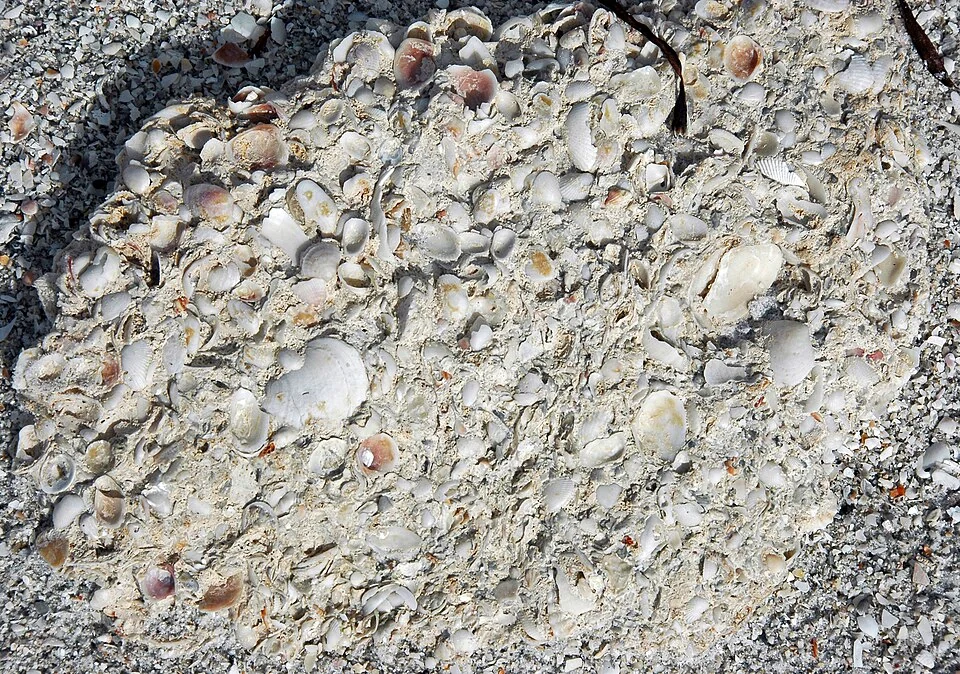
Talc specimen

Talc

Photographer / creator: Didier Descouens

License: CC BY-SA 4.0

Original: File:Talc.jpg

Resized to at most 960 pixels and converted to WebP; no cropping.

Source credit and review

Own work

Visual appearance and source description reviewed for the named mineral, variety or rock. Selected for visible diagnostic features; no specimen-name label is visible.

Crystals of talc .

Talc Schist (Soapstone) specimen

Talc Schist (Soapstone)

Photographer / creator: Ra'ike (see also: de:Benutzer:Ra'ike )

License: CC BY-SA 3.0

Original: File:Soapstone (Speckstein) - several colored samples.jpg

Resized to at most 960 pixels and converted to WebP; no cropping.

Source credit and review

Own work

Source description checked against the specimen; visual review confirms a usable crystal, aggregate or rock exposure without a specimen-name label.

Soapstone - several colored samples

Tiger’s Eye specimen

Tiger’s Eye

Photographer / creator: Marek Novotnak

License: CC BY-SA 4.0

Original: File:Tiger's eye.jpg

Resized to at most 960 pixels and converted to WebP; no cropping.

Source credit and review

Own work

Source description checked against the specimen; visual review confirms a usable crystal, aggregate or rock exposure without a specimen-name label.

Gemstone that is usually a metamorphic rock that is yellow- to red-brown.

Topaz specimen

Topaz

Photographer / creator: Parent Géry

License: CC BY-SA 3.0

Original: File:Topaze, quartz fumé 1.jpg

Resized to at most 960 pixels and converted to WebP; no cropping.

Source credit and review

Own work

Source description and visible appearance reviewed for specimen identity, diagnostic texture or crystal habit. Selected photo has no visible specimen-name label.

cristal de topaze sur cristaux de quartz fumé - Chamachhu, Haramosh Mounts, Skardu, Baltistan, Pakistan

Tourmaline specimen

Tourmaline

Photographer / creator: Parent Géry

License: CC BY-SA 3.0

Original: File:Tourmaline var. rubellite sur quartz (Brésil).JPG

Resized to at most 960 pixels and converted to WebP; no cropping.

Source credit and review

Own work

Visual appearance and source description reviewed for the named mineral, variety or rock. Selected for visible diagnostic features; no specimen-name label is visible.

cristal de tourmaline var. rubellite sur gangue de quartz

Travertine specimen

Travertine

Photographer / creator: Nessa Eull

License: CC0

Original: File:Travertine (GeoDIL number - 489).jpg

Resized to at most 960 pixels and converted to WebP; no cropping.

Source credit and review

https://geodil.dperkins.org/h/489.html

Visual appearance and source description reviewed for the named mineral, variety or rock. Selected for visible diagnostic features; no specimen-name label is visible.

This sample of travertine is about 10 cm across. Most travertine is white or cream colored, but it often contains layers of contrasting texture or color, and so polishes to produce a beautiful building stone. Travertine forms when calcium carbonate precipitates as calcite. It typically occurs in areas where circulating ground water passes through limestone and becomes saturated in calcium carbonate. Travertine often forms around the mouths of hot springs and in streams. The word travertine comes from an old Roman name for Tivoli, a town in Italy where large deposits of travertine occur. Travertine quarries at Tivoli provide much building stone for early rome, 20 miles away. In the United States, travertine forms around the Mammoth Hot Springs in Yellowstone National Park.

Tremolite specimen

Tremolite

Photographer / creator: Didier Descouens

License: CC BY-SA 4.0

Original: File:Tremolite Campolungo.jpg

Resized to at most 960 pixels and converted to WebP; no cropping.

Source credit and review

Own work

Source description checked against the specimen; visual review confirms a usable crystal, aggregate or rock exposure without a specimen-name label.

Tremolite Locality : Campolungo, Piumogna Valley, Leventina, Ticino (Tessin), Switzerland -TOPOTYPE Size : 14x6.4cm

Tuff specimen

Tuff

Photographer / creator: Ivan Fernanadez 1011

License: CC BY-SA 4.0

Original: File:Guadalupe Tuff.jpg

Resized to at most 960 pixels and converted to WebP; no cropping.

Source credit and review

Own work

Source description checked against the specimen; visual review confirms a usable crystal, aggregate or rock exposure without a specimen-name label.

A sample of volcanic tuff from Caysio, Santa Maria, Bulacan

Tuff Breccia specimen

Tuff Breccia

Photographer / creator: James St. John

License: CC BY 2.0

Original: File:Volcanic breccia.jpg

Resized to at most 960 pixels and converted to WebP; no cropping.

Source credit and review

https://www.flickr.com/photos/47445767@N05/16600887960/

Volcanic breccia hand specimen with angular fragments in an ash-rich matrix. Source describes explosive ash deposits lithified into volcanic breccia; used as the tuff-breccia teaching representative.

Igneous rocks form by the cooling & crystallization of hot, molten rock (magma & lava). If this happens at or near the land surface, or on the seafloor, they are extrusive igneous rocks. If this happens deep underground, they are intrusive igneous rocks. Most igneous rocks have a crystalline texture, but some are clastic, vesicular, frothy, or glassy. Volcanic breccias are clastic-textured, extrusive igneous rocks. They generally appear as multicolored, jumbled masses of angular grains. Volcanic breccias have violent origins. They form from explosive volcanic eruptions (cf. effusive eruptions/lava flows). Volcanoes having felsic or intermediate chemistries typically erupt violently. Powerful volcanic ash eruptions result in deposits with mixes of large & small grains. Upon burial & lithification, these deposits become volcanic breccias. The clastic texture of volcanic breccia is often termed pyroclastic or volcaniclastic.

Turquoise specimen

Turquoise

Photographer / creator: Lê Phạm Gia Hy

License: CC BY-SA 4.0

Original: File:Raw-hubei-turquoise.jpg

Resized to at most 960 pixels and converted to WebP; no cropping.

Source credit and review

https://kimquigems.vn/bach-khoa-da-quy/turquoise/ngoc-lam-turquoise-dac-diem-nguon-goc-va-gia-tri/

Visual appearance and source description reviewed for the named mineral, variety or rock. Selected for visible diagnostic features; no specimen-name label is visible.

raw hubei turquoise in hand

Ulexite specimen

Ulexite

Photographer / creator: Marie-Lan Taÿ Pamart

License: CC BY 4.0

Original: File:Ulexite Boron Minéraux SU.jpg

Resized to at most 960 pixels and converted to WebP; no cropping.

Source credit and review

Own work

Fibrous ulexite from Boron in the Sorbonne University collection. Replaces an earlier candidate with its name written on the specimen.

Ulexite from Boron, California, USA. Sorbonne University mineral collection.

Vanadinite specimen

Vanadinite

Photographer / creator: Didier Descouens

License: CC BY-SA 4.0

Original: File:Mibladene Vanadinite.jpg

Resized to at most 960 pixels and converted to WebP; no cropping.

Source credit and review

Own work

Source description checked against the specimen; visual review confirms a usable crystal, aggregate or rock exposure without a specimen-name label.

Vanadinite Locality: Mibladene (Mibladén; Mibladan; Miblanden), Upper Moulouya lead district, Midelt , Khénifra Province , Meknès-Tafilalet Region, Morocco Size: 9x6x5.8 cm.

Willemite specimen

Willemite

Photographer / creator: Christian Rewitzer

License: CC BY-SA 3.0

Original: File:Willemite-130544.jpg

Resized to at most 960 pixels and converted to WebP; no cropping.

Source credit and review

http://www.mindat.org/photo-130544.html

Visual appearance and source description reviewed for the named mineral, variety or rock. Selected for visible diagnostic features; no specimen-name label is visible.

Willemite Locality: Berg Aukas (Berg Aukus), Grootfontein District, Otjozondjupa Region , Namibia ( Locality at mindat.org ) Picture width 7 mm. Collection and photograph Christian Rewitzer

Wollastonite specimen

Wollastonite

Photographer / creator: Shannon Heinle

License: CC0

Original: File:Wollastonite (GeoDIL number - 1634).jpg

Resized to at most 960 pixels and converted to WebP; no cropping.

Source credit and review

https://geodil.dperkins.org/h/1634.html

Visual appearance and source description reviewed for the named mineral, variety or rock. Selected for visible diagnostic features; no specimen-name label is visible.

Wollastonite has ideal chemical formula CaSiO3, but natural wollastonite generally contains some other, but very minor, elements. Wollastonite is a common mineral in skarns and high temperature (granulite facies) marbles. This sample is about 7 cm across.

Zincite specimen

Zincite

Photographer / creator: © Raimond Spekking / CC BY-SA 4.0 (via Wikimedia Commons)

License: CC BY-SA 4.0

Original: File:Zincite, Franklinite, Calcite. Franklin, New Jersey, USA-8954.jpg

Resized to at most 960 pixels and converted to WebP; no cropping.

Source credit and review

Own work

Red zincite with black franklinite and pale calcite from Franklin, New Jersey; selected instead of the questionable Arizona needle-crystal photo.

Zincite , Franklinite , Calcite (Weight: 178,36 g) – Franklin, New Jersey, USA
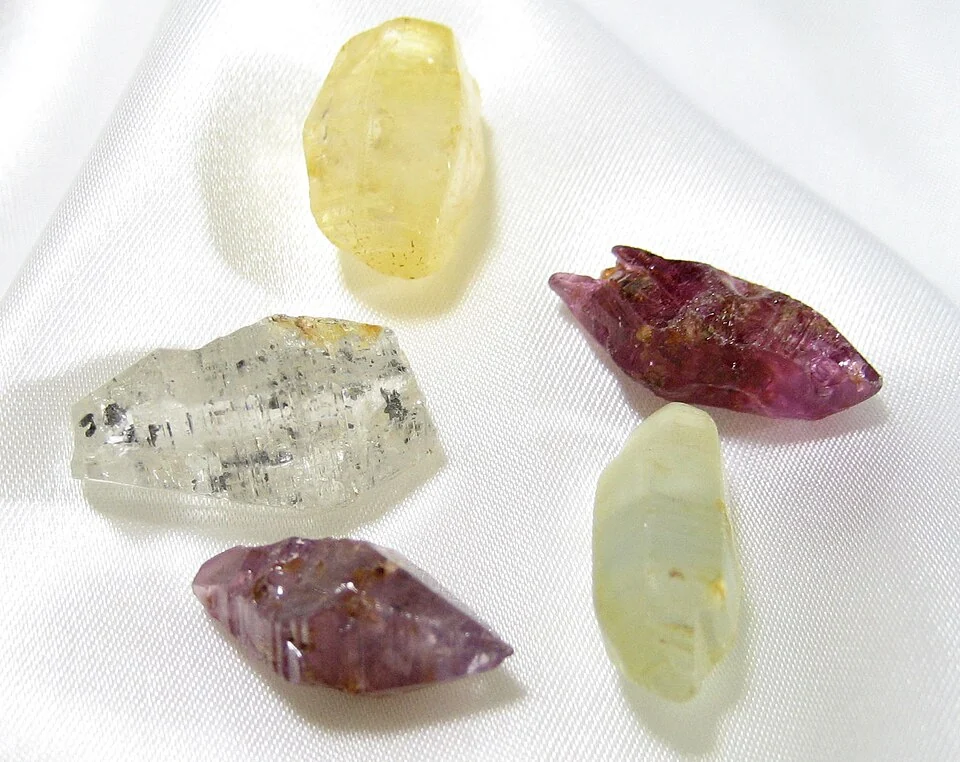
Zircon specimen

Zircon

Photographer / creator: Rob Lavinsky, iRocks.com – CC-BY-SA-3.0 · iRocks.com

License: CC BY-SA 3.0
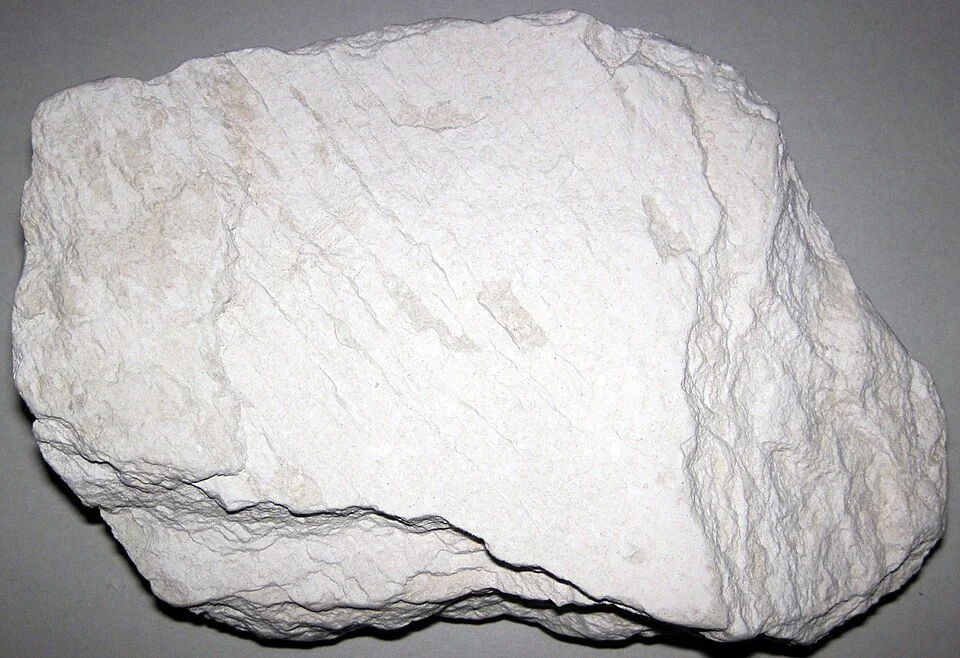
Original: File:Zircon-tuc1001a.jpg

Resized to at most 960 pixels and converted to WebP; no cropping.

Source credit and review

Image: http://www.irocks.com/db_pics/new2010/tuc1001a.jpg , Description: http://www.irocks.com/render.html?species=Zircon&page=4

Visual appearance and source description reviewed for the named mineral, variety or rock. Selected for visible diagnostic features; no specimen-name label is visible.

Zircon Locality: Thabeikyin, Mogok , Sagaing District, Mandalay Division , Burma (Myanmar) ( Locality at mindat.org ) Size: miniature, 3.4 x 1.4 x 1.4 cm Zircon This is an approximately 23-gram specimen of TOTALLY GEMMY, transparent, olive-green zircon! It is unusual for both the size, the color, and the translucency, and is a major Mogok gem crystal specimen, thus. The piece has a very sharp and equant termination, though exhibits slight water-worn surfaces characteristic of many gems from the Mogok gem tracts. Old specimen, from finds of the mid to late 1990s,sold by "Burma Bill" Larson from his collection to a collector at that time. I have seen no other comparable. In halogen lights it looks a bit yellowish, and in fluorescents (as shown) a bit more green in color.